MFW Adventures: War of 1812, Star Spangled Banner & Lewis and Clark

IMG_8718.JPG

We studied the War of 1812 last year during cycle 3 of Classical Conversations. The minute the boys saw our topic of study they launched into the corresponding song, “The war of 1812, gave confidence to the US to write the Monroe doctrine…”

I made several recordings of their young warmly voices as they sang out “The Star Spangled Banner.” Its difficult to imagine what they will sound like a few years from now.

We recreated the Battle of Ft McHenry in our bathtub. We will not be sharing those pictures. Suffice to say, there was a great deal of water outside the tub when it was all said and done!

After spending the first two days of our unit reading about the War of 1812 and the writing of the Star Spangled Banner, the boys asked if we could take a detour with Lewis & Clark. I love homeschool detours. We always learn so much! Here’s what happened…

IMG_8707.JPG

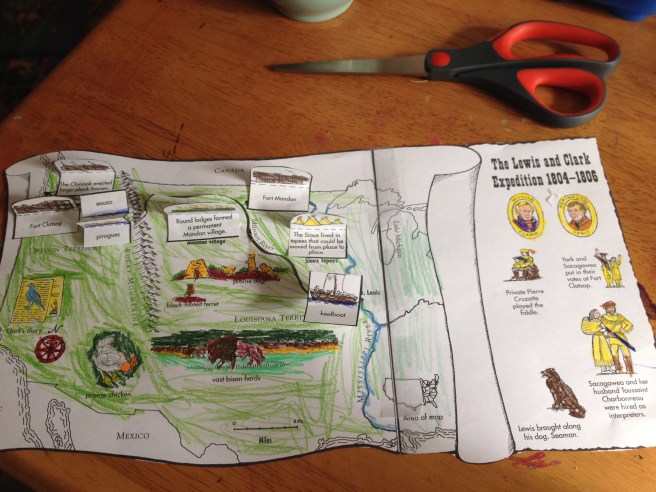
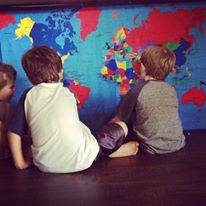
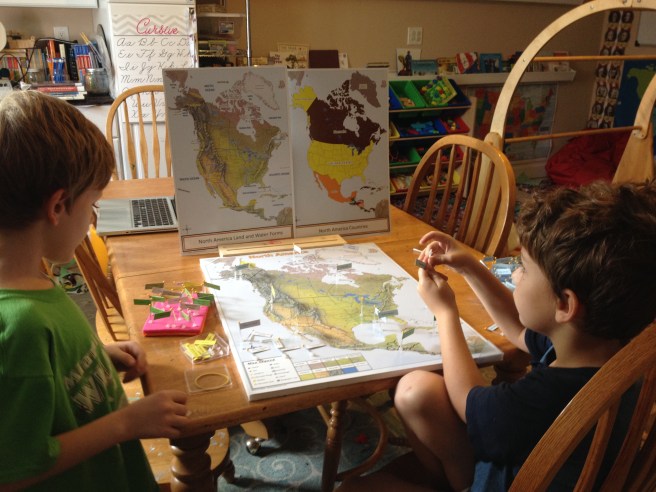
We jumped in with our Interactive 3D American History maps. 
We looked up the various Indian tribes and geographical features mentioned on the map. The boys were very excited about researching these terms in their child craft encyclopedias.

IMG_8714.JPG
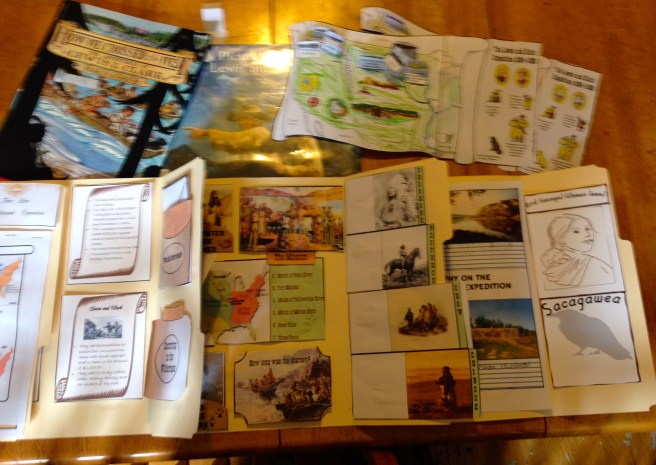
We made a lap book from Tina’s Dynamic Homeschool Plus. All the printouts were free and easy to assemble. We listed defining characteristics of various tribes, studied botany and mapped out Lewis and Clark’s route.

We printed out the corresponding coloring sheets to fill in while I read aloud from our Louisiana Purchase book list (see below).

We played a really fun Lewis & Clark Westward Bound board game. The cards relay information about the trip at each stop along the map.

IMG_8679.JPG

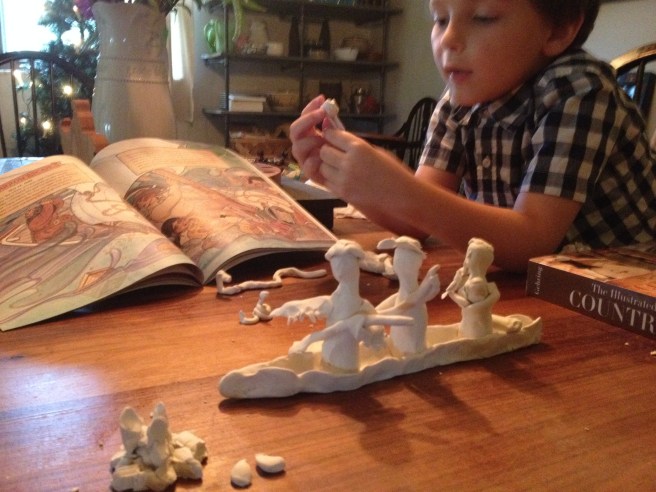
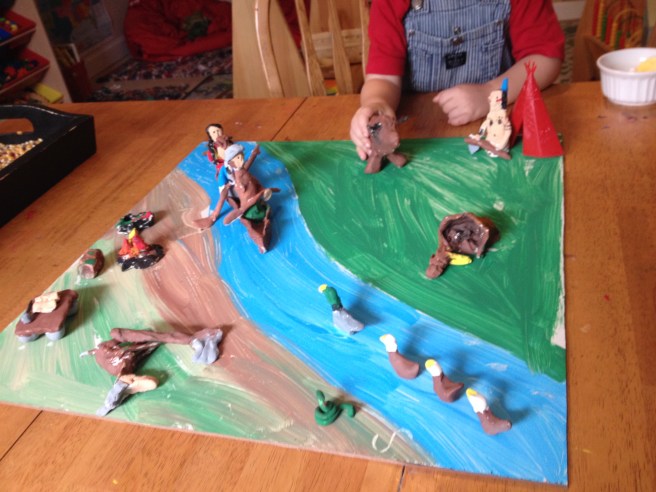
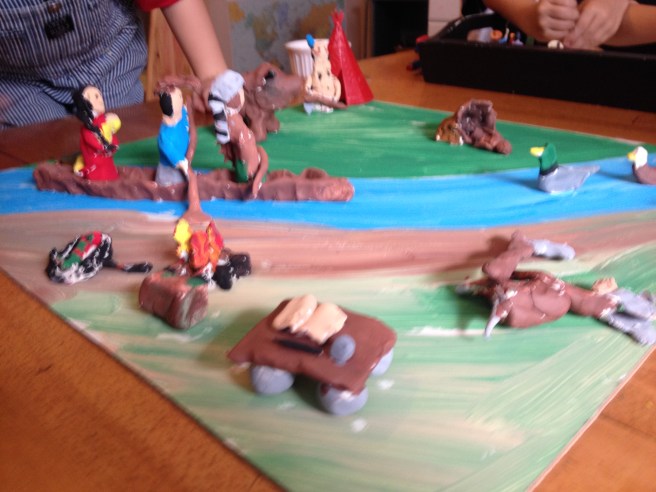
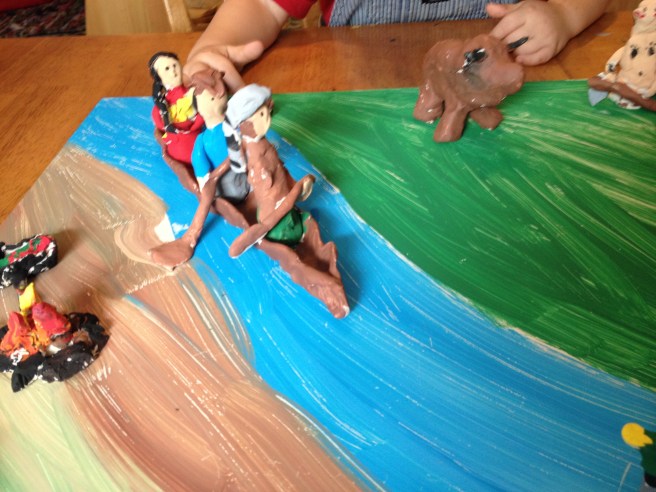
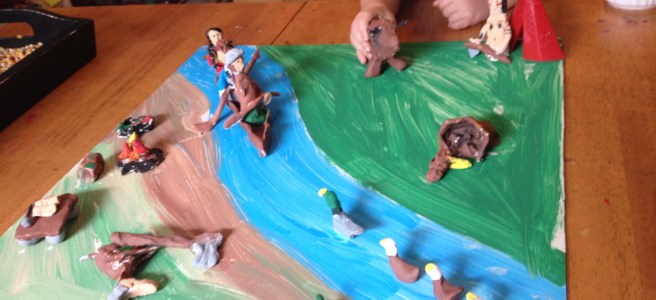
Lastly, I purchased a few pounds of white sculpty clay and the boys fashioned pieces for our Corps of Discovery diorama. I read aloud from a few books written from the experience of Seaman, the massive Newfoundland dog that accompanied Lewis and Clark on their journey.

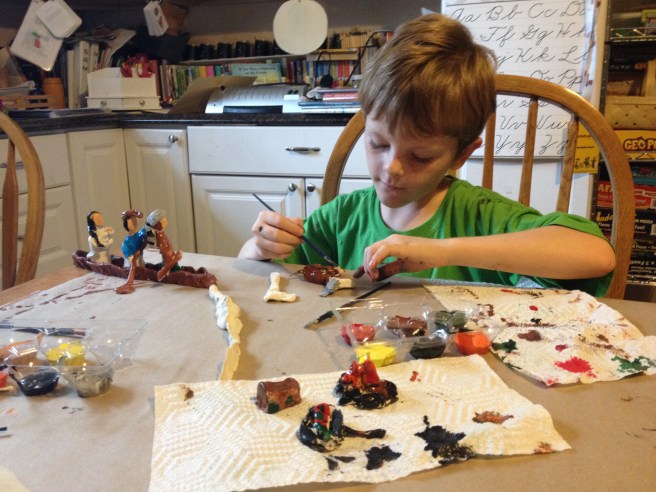
We baked the pieces in the oven and then painted them a few days later.

IMG_8721.JPG

IMG_8728.JPGIMG_8730.JPGIMG_8729.JPG

This was a great project! I love how hands on it was. I also got a lot of reading in while they worked and afterwards, while they played.

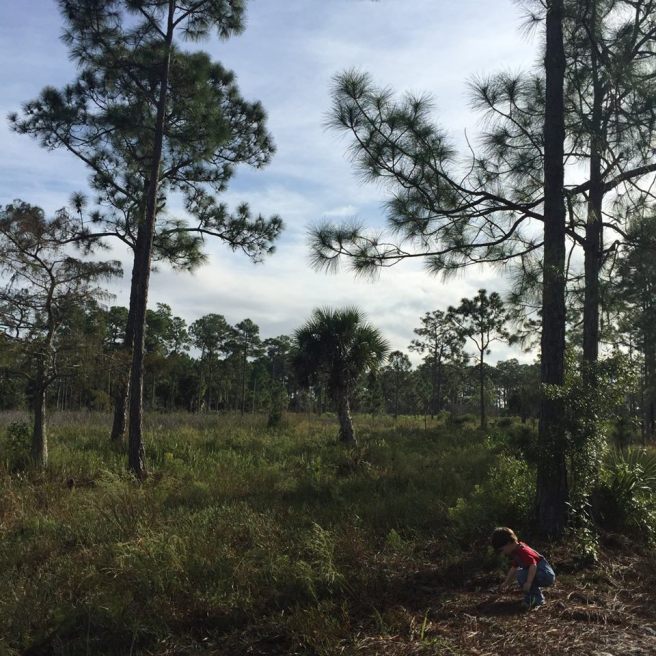
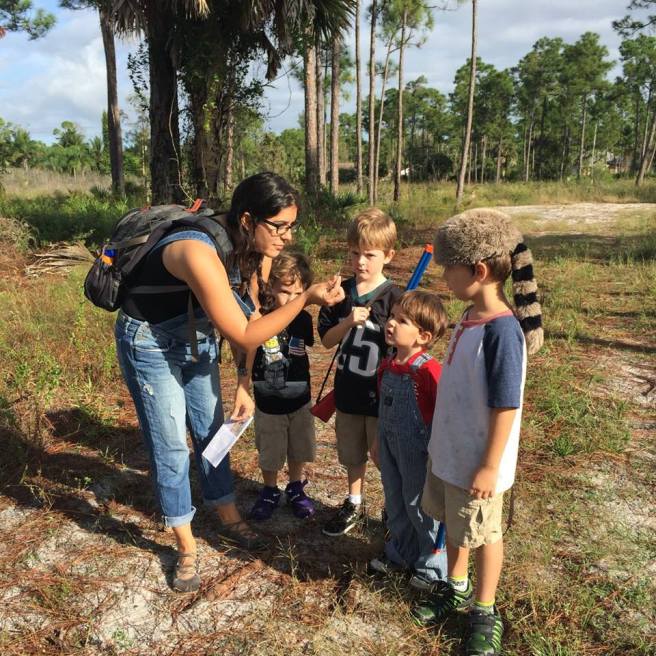
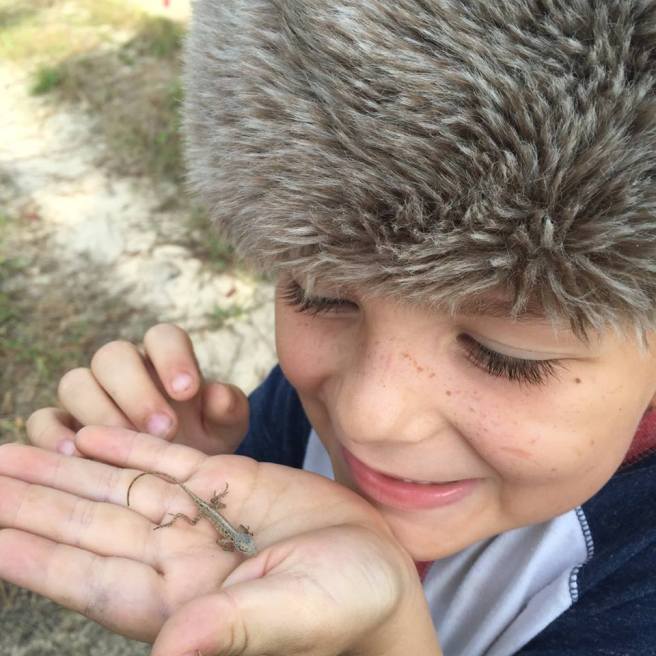
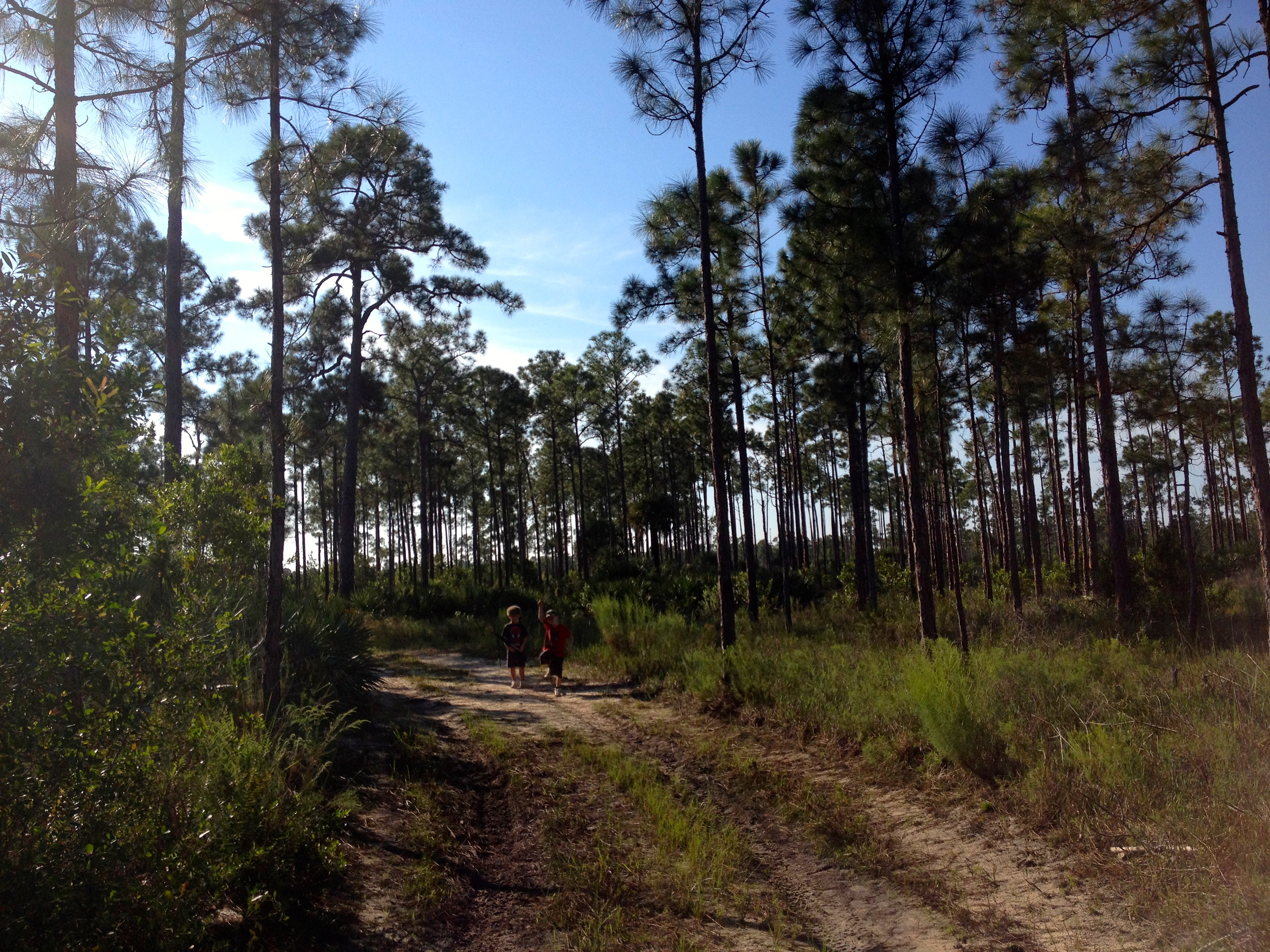
On Friday, we went for our usual nature walk. The boys had spent the week cataloging the plants in our backyard. We dissected a bird of paradise flower and labeled each part. I had seen a great link for making your own grocery bag nature journals, a la Merriweather Lewis. I had planned to let the boys fill their homemade journals with drawings of native plants as though they were the original discoverers.

12239866_10153237773503616_7819363253561514950_n.jpg

11222344_10153237773633616_953807943781542643_n.jpg

12243442_10153237776703616_6933596891181340243_n.jpg

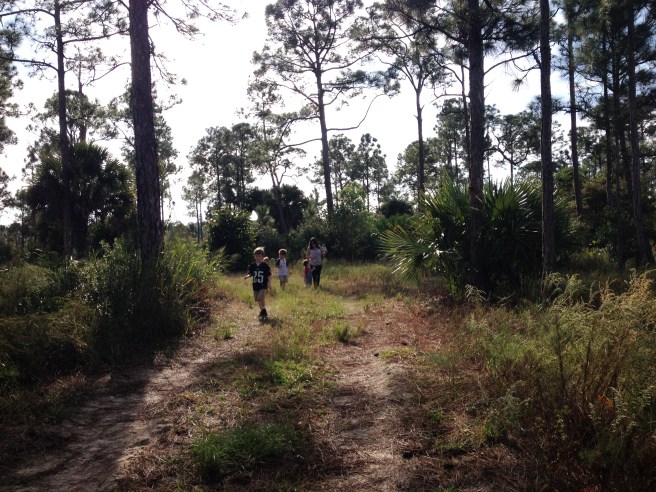
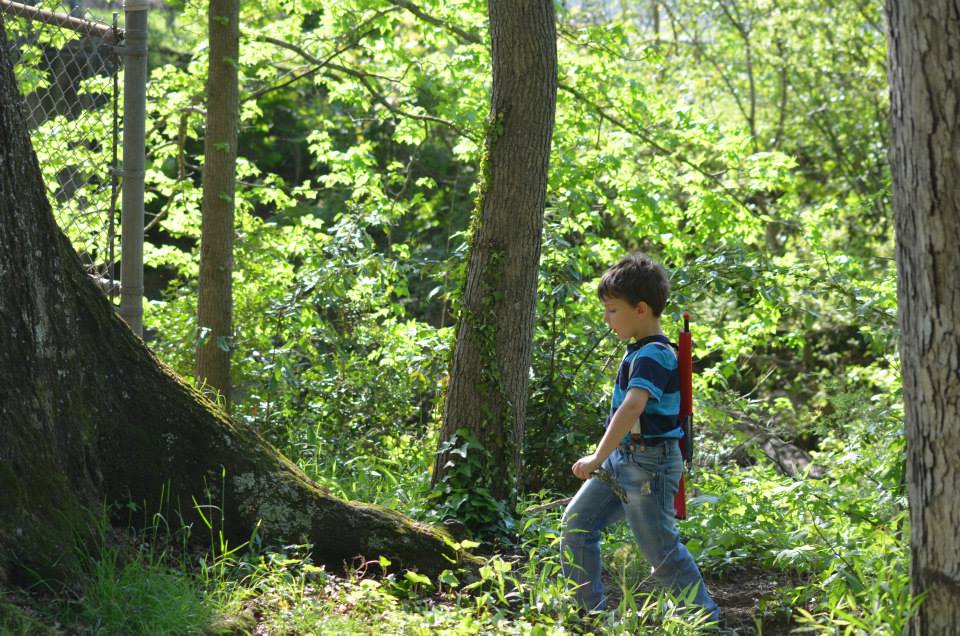
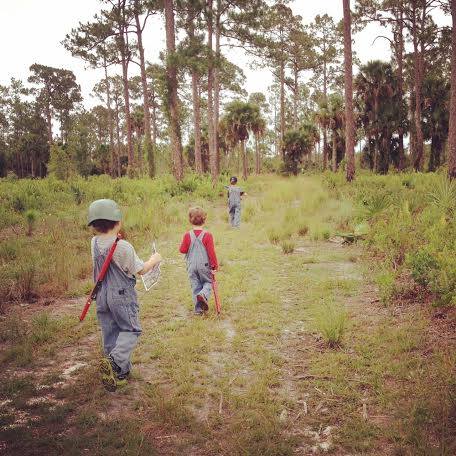
In the end, I opted to just let them enjoy the great outdoors with a project in mind.
IMG_8727.JPG

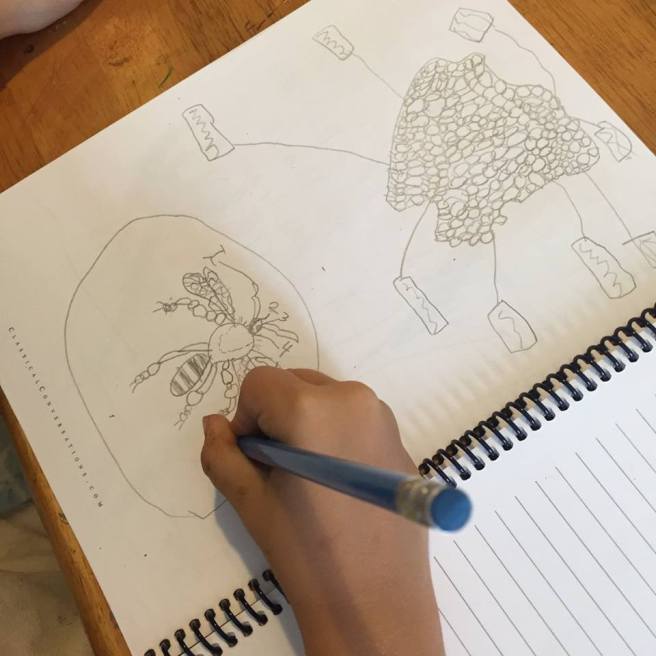
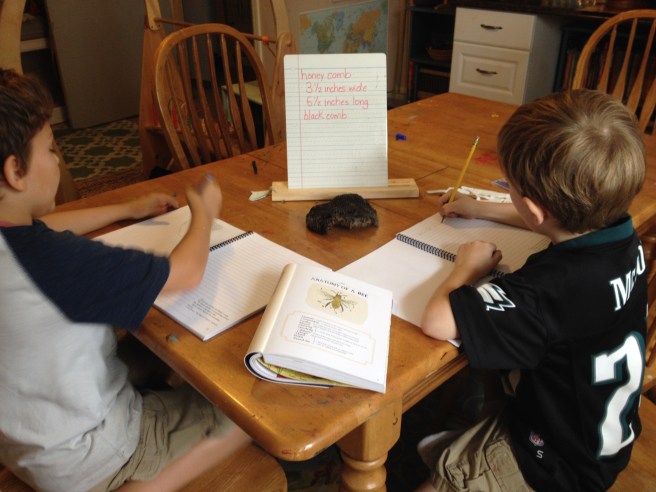
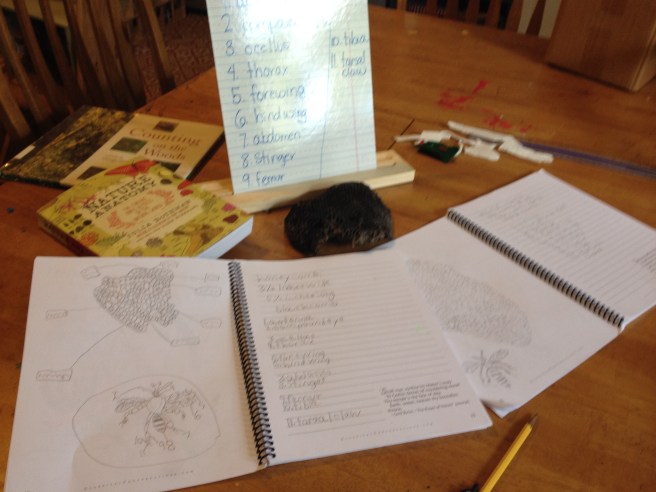
When we returned home, they worked on their natural journals and sketched a large piece of brood comb from one of our pine trees. They also sketched a honey bee and labeled its parts.

12241709_10153237784328616_7093347670251621084_n.jpg

IMG_8747.JPGIMG_8749.JPG
I’m glad we did this instead of the journal. They were much more excited to sketch bees today. Some days, its better to let them lead their own learning.

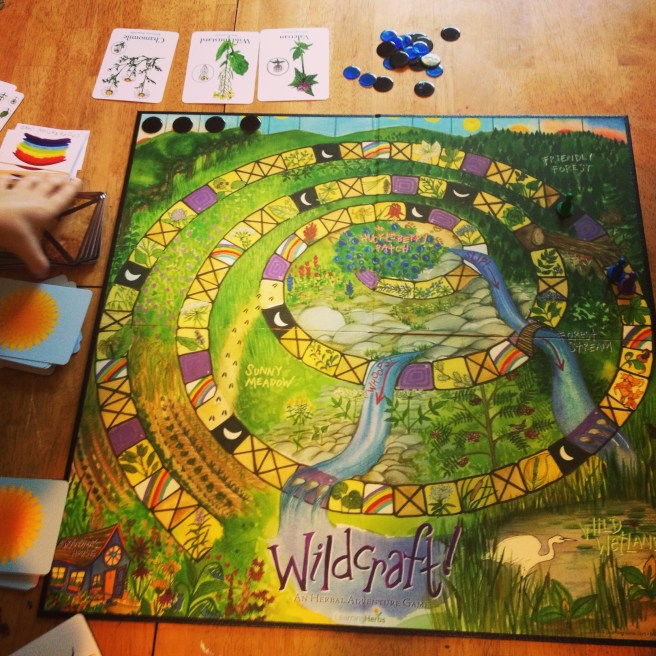
We ended the week by playing one of our new favorite board games, Wildcraft,  in honor of those crazy botanist/explorers Lewis & Clark.
IMG_7554.JPG

Louisiana Purchase, Lewis & Clark Expedition Reading List

How We Crossed the West: The Adventures of Lewis and Clark by Rosalyn Sanchez
Lewis and Clark: The Story of Our Nation from Coast to Coast, from 1801-1850 by Sally Isaacs 
Lewis and Clark: A Prairie Dog for the President by Shirley Raye Redmond
The Louisiana Purchase: Would you close the deal? by Elaine Landau
The Lewis and Clark Expedition (Graphic History) by Jessica Gunderson
Seaman’s Journal: On the Trail with Lewis and Clark by Patricia Eubank

We’ll be taking the next week off and I plan to read “Of Courage Undaunted” by James Daughtery.


For the Birds– Birding & Resource List

Bird watching with tiny ornithologists is no easy feat.
IMG_7641There is a constant flood of noise trumpeting our arrival minutes before we reach the glades that hold our most sought after birds. They often take flight before we even get there. Chances are, if we venture out of the house in search of a specific bird and preschoolers are in tow, we won’t have much luck.

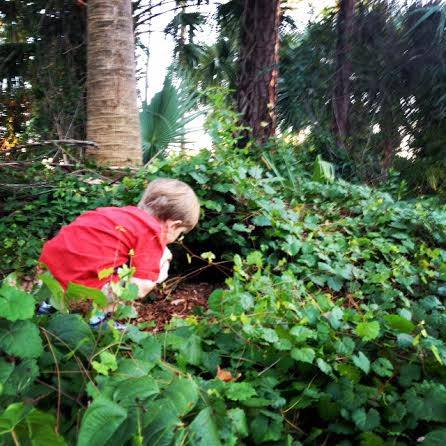
So we learned to look for signs of birds around us. Discovering their nests, learning about their feeding habits, watching for patterns in their departures and returns to the neighborhood. We set up bird feeders in our trees and left colorful yarn in the back hollow for the birds to use when building their nests.

We stopped to listen.

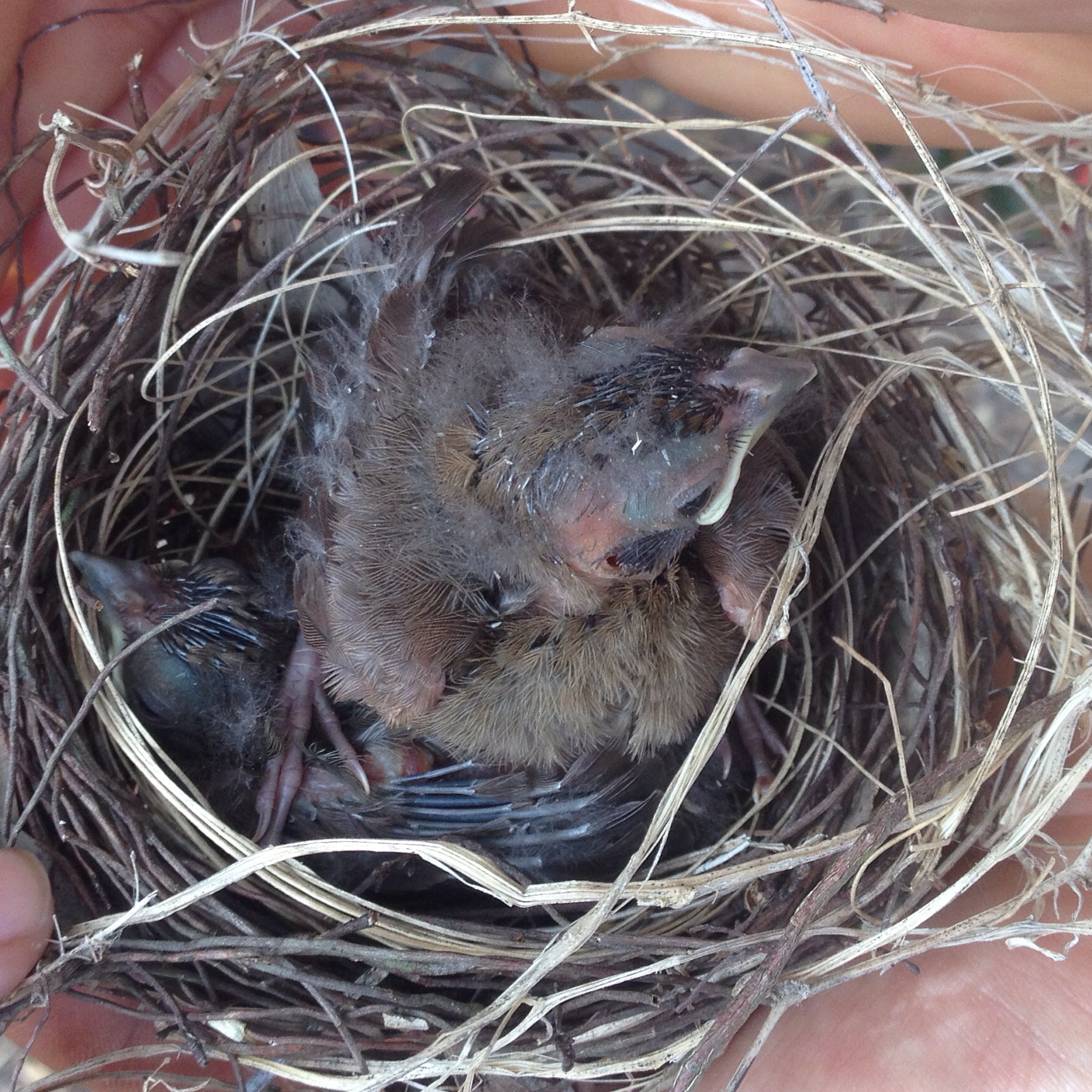
Because we slowed down we heard the tiny chirps of baby cardinals tucked high in the limbs of our jasmine tree. We were there the day the nest tumbled down after a particularly bad storm. We scooped up the nest and quickly tucked it back in place.
IMG_4807 We started collecting abandoned nests in the late summer once the squirrels started knocking them down from the trees.

We know where the owl lives in the back hollow. Its small and brown and we love to look for its pellets. His head can rotate in the most alarming ways.

When the baby mockingbirds flew away from their nest, we peaked inside and found one egg that never hatched. Frail and small; blue and perfectly speckled. Dwarfed when held next to one of our chicken’s eggs.  We marveled at it.

The gaggle of ibis that frequent our yard, their long hooked beaks and funny legs probing the grass. They’ll hunt for bugs alongside our chickens.

The flash of bashful pink under the pines when the roseate spoonbill comes to visit.

Sandhill cranes, poking around the fence, stretching to their full height of 3-4 feet, look like nosy neighbors. The Gladys Kravitz of the bird world.

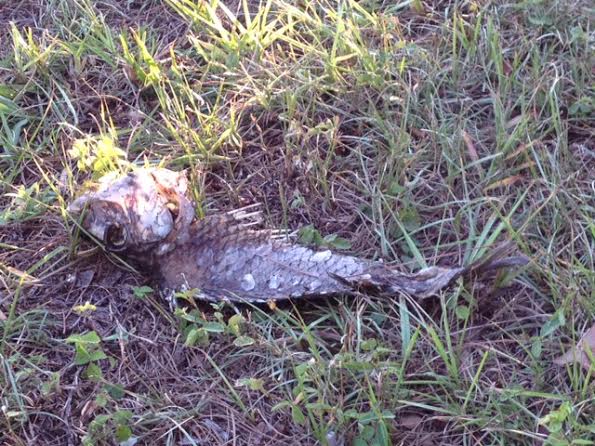
Our proximity to the Everglades provides us with a wide variety of birds to watch in our own yard if we simply sit down and look up. Peregrine falcons, hawks, and other raptors abound out here. We are even visited with some frequency by a beautiful bald eagle. We hear the loud screeches of these raptors as they close in on their prey. We find remnants of their meals on the ground beneath the towering pines near the orchard. The back end of a rabbit. The head of a small bird. A gutted fish.

unnamed
Tell me about the robin’s nest? Where is it located? What is the nest made of? What does the robin eat? We discovered these answers over days of rambling about the farm, remembering to keep our eyes and ears open. Pirate raids and jousting tournaments put on pause when we heard the familiar call of the blue jay that lives in the oak tree. We watched the epic battles between the jays and mockingbirds unfold before our very eyes. Quick turns out to the yard after breakfast to stop and listen under a nest teeming with young. We watched them grow up and fly away.

We spent time writing down the things we saw and when we saw them. Recording our findings helped us to see the patterns. The exquisite formula of nature.

18829_10152835070403616_3731618734268663438_n
Two weeks ago we drove to a bird trail and found the gates locked. The boys were terribly disappointed. As we slowly drove home along the canal, we encountered a large stork, lit up by the early morning rays, a long snake dangling from his beak. I stopped the car and we stared at him in silence as he slowly slurped the snake down his throat like spaghetti. Nature always finds us, even on days when we are turned away at the gate.
11426185_843858959598_3746677832569009679_n
Yet the boys were determined to begin their own birding expeditions away from our yard. So I set about slowly teaching the boys how to birdwatch on the trail.

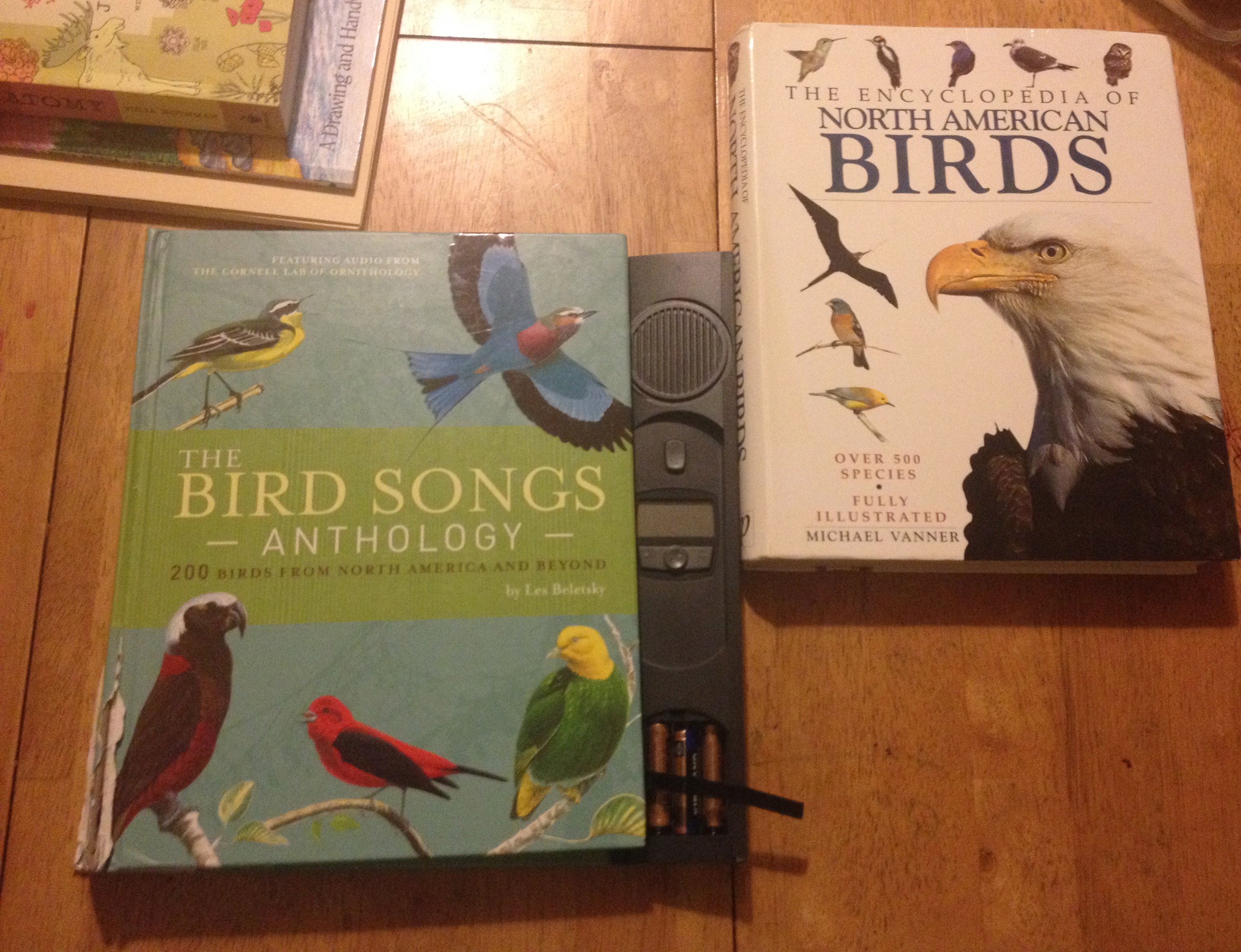
We started out by reading “Take a Backyard Bird Walk” by Jane Kirkland.  This is a fantastic introduction to the world of birding. How to find nests, learning about habits and migration, even learning how to determine what a bird eats based on the shape of its bill. There are blank pages for observation notes. This is not a book for bird identification but rather a birding “how to.” Truly, a great find that cements birding in the backyard and helped transition us to birding on the trails.

A few other books have sat on our school table, providing information and vocabulary tools for any curious passersby.

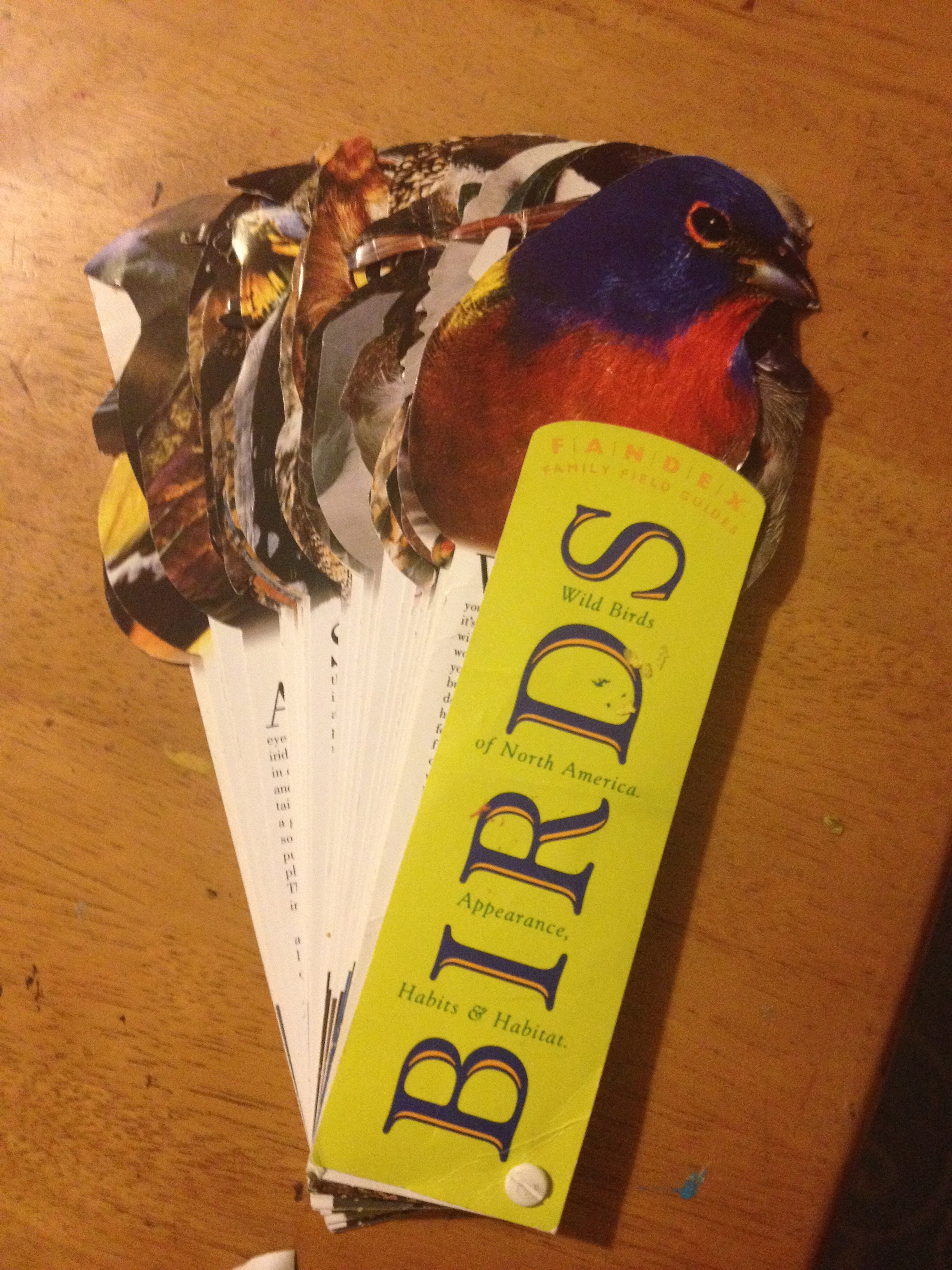
IMG_7931Along with the house favorite Fandex….

IMG_7933

We started with our native birds. Two at a time. We loaded our ark with knowledge in this way. We drew pictures and watched quick youtube videos about each bird. We squinted up into the sky in search of them.

We learned how to pack for our nature hikes. I learned to always bring a snack for the loudest preschooler. It keeps him quiet and out of trouble. I recommend our recipe for Audobonbons.
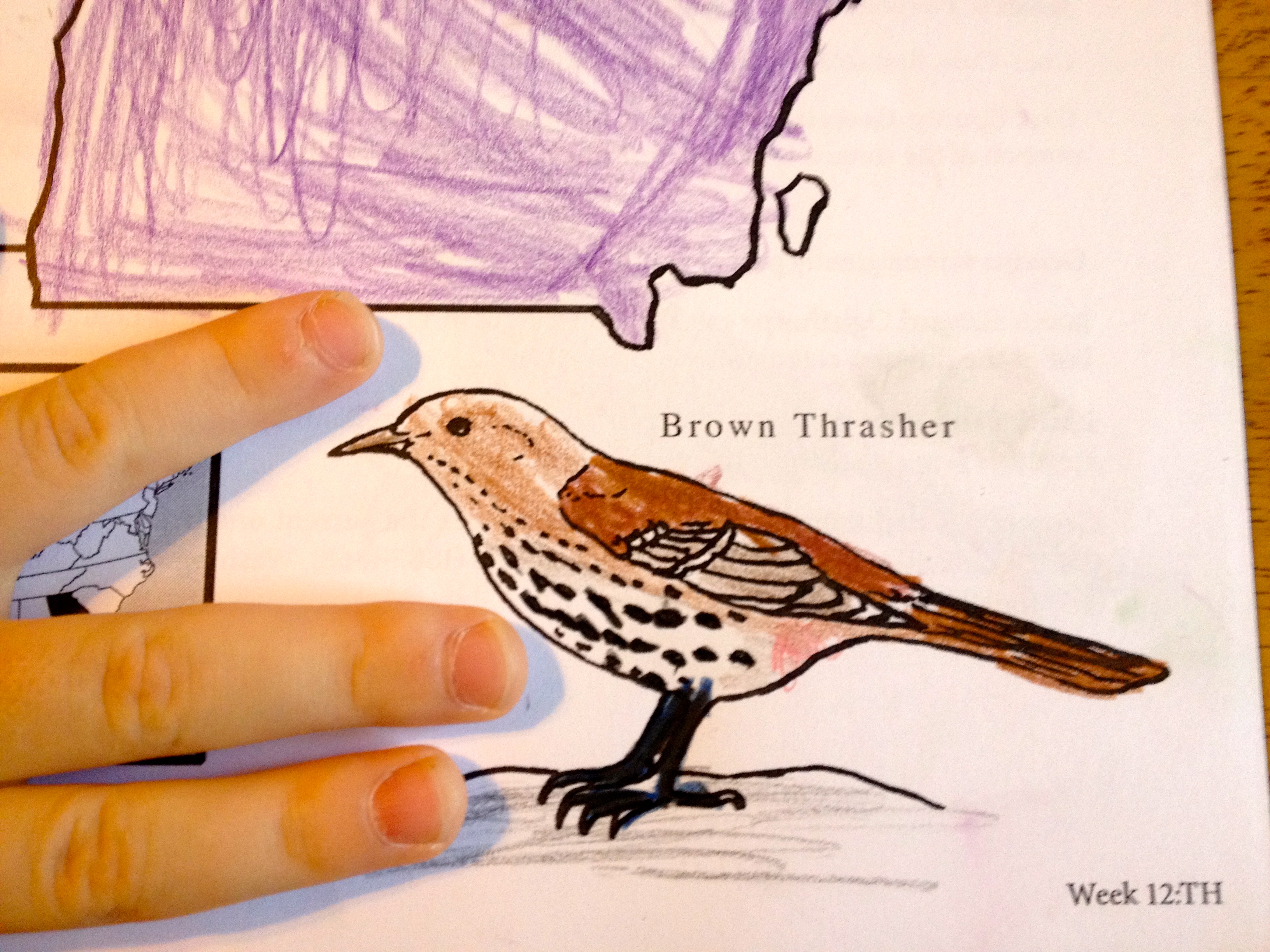
We record our findings and remember to check in with our local Audubon Society for help identifying unknown birds we encounter. Birding with littles can be challenging. Teaching children to be purposeful in their nature walks is challenging too. Both are incredibly fun and rewarding.
What started out as a brief unit study for My Father’s World Adventures in US History has become a lifestyle habit. We observe and record birds. They are familiar to us. They are part of our life rhythm here on the farm.  Birding teaches us to classify, record, relate, recall, and dialogue. It is now an integral part of nature study for us.

1503255_793698741078_1558814935352485454_n
Here are a few other tools and resources we use in our ongoing bird study.

Booklist:
Mama built a Nest by Jennifer Ward
Birds, Nests and Eggs by Mel Boring
Feathers, Not Just for Flying by Melissa Stewart
What Makes a Bird a Bird? by Mary Garelick
A Nest Full of Eggs by Priscilla Belz Jenkins
About Birds: A Guide for Children by Cathryn Sills
The Bird Alphabet Book by Jerry Pallotta
Feathers for Lunch by Lois Elhert (great for the littles!)
The Burgess Bird Book for Children by Thornton W Burgess
Beaks! by Sneed B. Colard III
An Egg is Quiet by Dianna Hutts Aston
Birdsong by Audrey Wood
Our Yard is Full of Birds by Anne Rockwell
Two Blue Jays by Anne Rockwell

img_7142Activities:
Bird Bingo: A family favorite! There is also this version which features lovely hand drawn illustrations instead of pictures.
Lego Birds Model Kit: Bluejay, Hummingbird and Robin. They come with stands and a little sign inscribed with their latin names.
Bird Printables: I discovered these gorgeous printables  off the delightful homeschool blog Chaos Meets Creativity. We used our printables around the house on a rainy day. I perched them on picture frames or high on shelves. The boys took their toilet paper roll binoculars and practiced spotting them an identifying them.
State Birds & Flowers 1000 piece puzzle
Birds of the Backyard 1000 piece puzzle
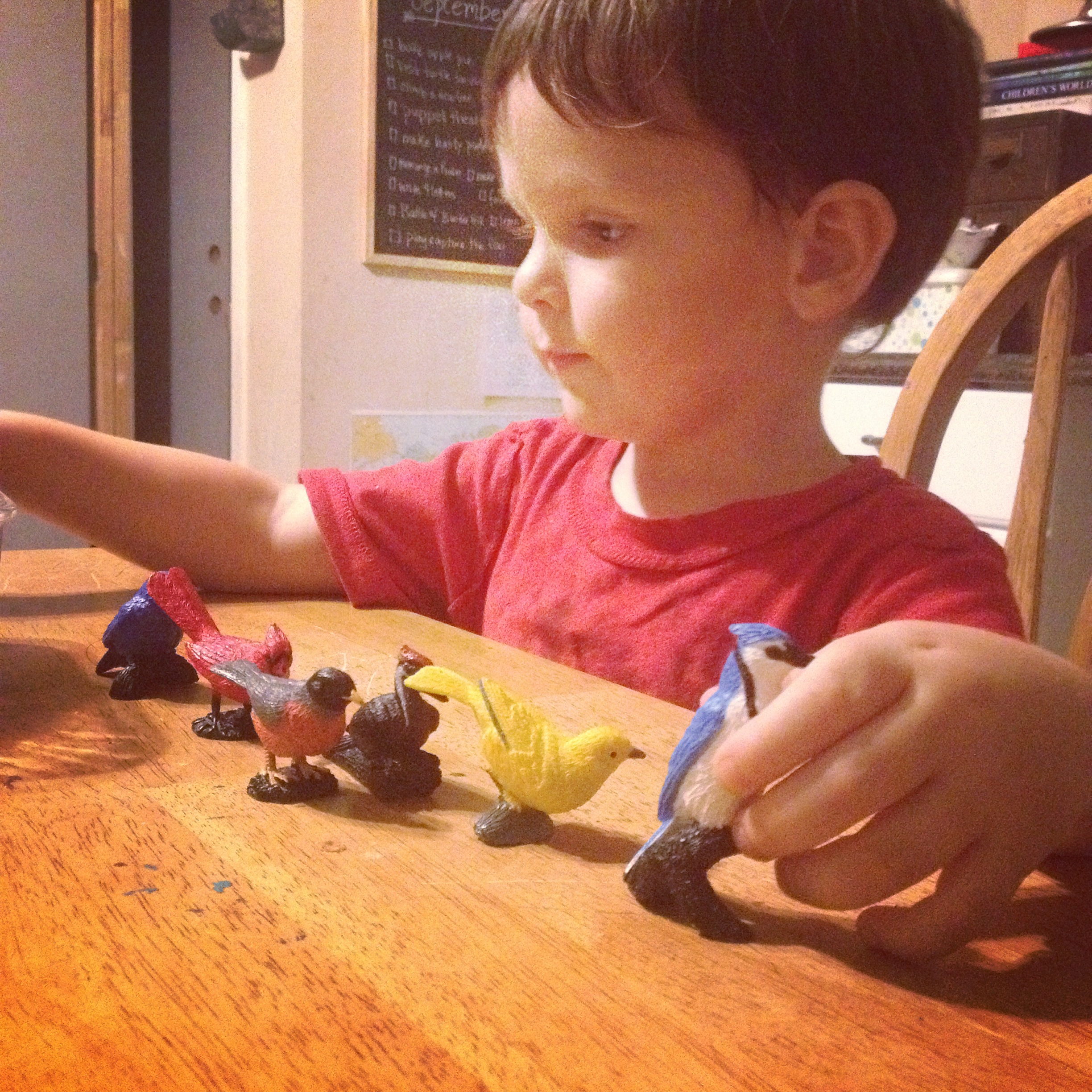
Backyard Birds toob: We always use our 40% off coupons at Hobby Lobby for these. They work in sensory bins, working with ordinal numbers or color sorting, and we love to make homes for them out of playdoh.

IMG_7934

Online Resources:
Xeno Canto: The largest online collection of bird sounds 
550 North American Bird Calls
: specific to N.A.
All About Birds: Learn how to listen to and identify, bird calls. Browse the rest of the site for great information on birds!
10000 Birds:Loaded with info on birding and conservation
Nature Songs: More North American bird calls
Where do you want to go Birding today?: Database of the best place to go birding worldwide
There are some websites with bird calls specific to each state.
Florida
Wisconsin
Lots more if you do a google search of your state + birds!

Art Appreciation + Resource List

“We cannot measure the influence that one or another artist has upon the child’s sense of beauty, upon his power of seeing, as in a picture, the common sights of life; he is enriched more than we know in having really looked at even a single picture.”—Charlotte Mason

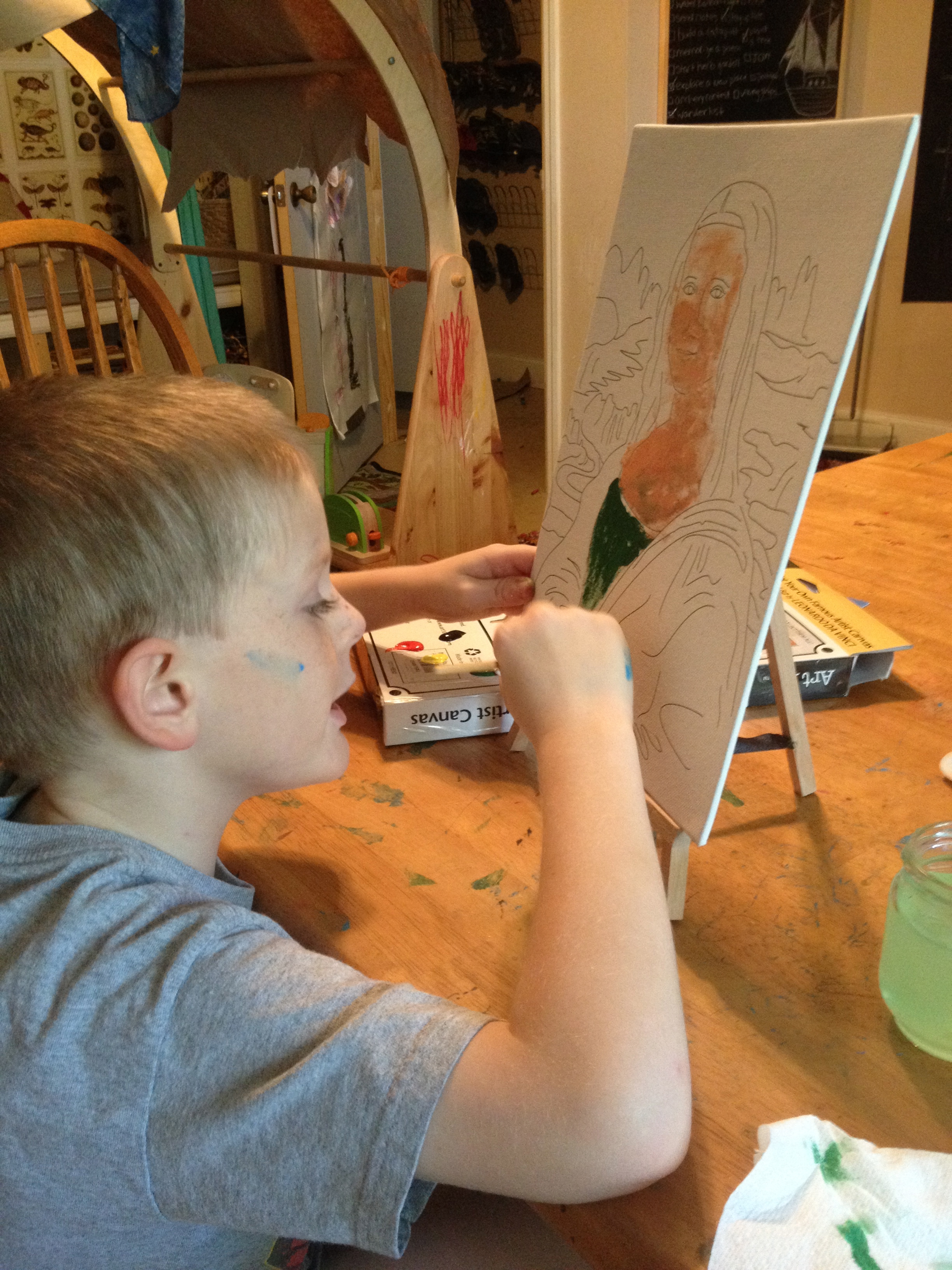
I want art to be a part of the mold that serves to shape my children into the adults they will one day be.

Art trains our eyes to behold life with wonder. Studying art adds texture to our history timeline. Art adds depth to stories and breathes life into our everyday academics. Art provides a space for souls to encounter and reflect.  Art calls us to create. Art is a valuable and worthy use of our time.

Teaching children to appreciate art felt like a daunting prospect when I first started. While my lovely sister was always supremely gifted with art, I was gifted in the art of hacking together a *good enough* project. I could *kind of* make art. I certainly knew how to appreciate various forms of art, but in the execution department, I was sorely lacking. When it came time to teach my children, I felt a bit overwhelmed and more than a little underprepared.
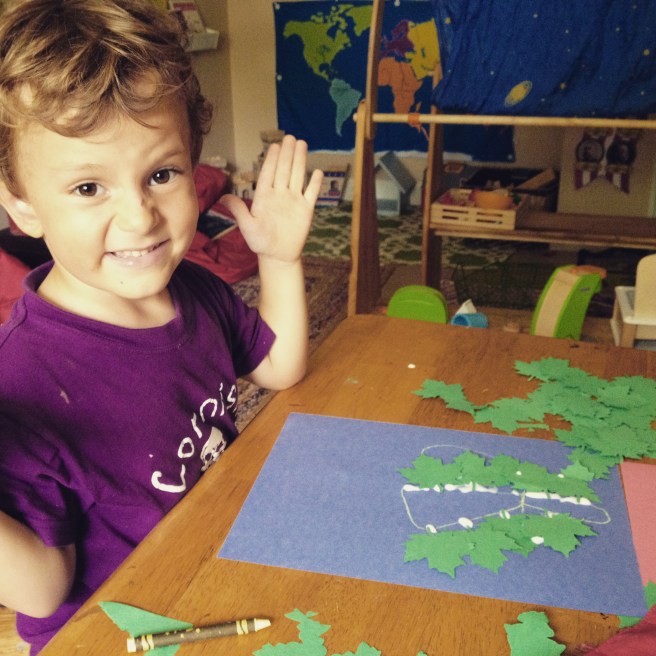
IMG_4450

One child loved art, one child hated it. One child loved to make and break, one child could not bear to touch anything weird. One child loved Picasso and Monet, one child repeatedly asked “is this over yet?”
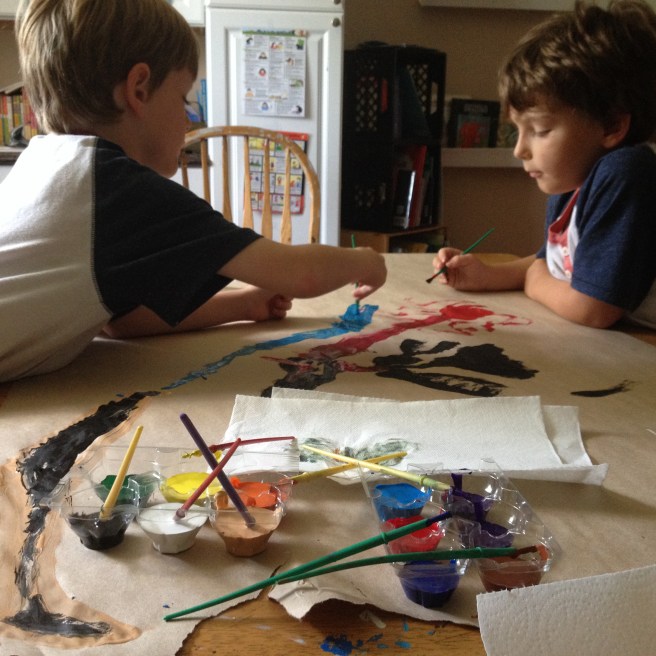
IMG_4479All of them are growing to love and appreciate art.

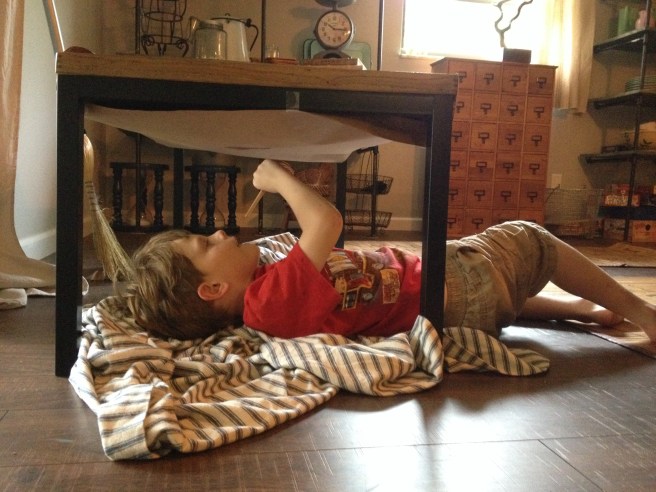
When did that happen? It happened over time. Growing up with art takes time.
IMG_2974
If you’ve been following, you know I am not a “Top Ten Ways to” or “How to Perfect…” kind of blogger. But I do love me some philosophy of Education. After tons and tons of reading over the years, I have learned to approach any subject I teach like some weird Classical/Charlotte Mason Ninja with Montessori-ish throwing stars sporting a Fred Rogers Tshirt. Whether its the Trivium, or Charlotte’s 4 R’s (Reading, Reasoning, Relating, Recording), when I approach something I have a system in mind and a mantle of compassion and grace balanced precariously on my shoulders. Ahem, and *reinforcements in the pantry. *Read: chocolate and wine.
IMG_7597
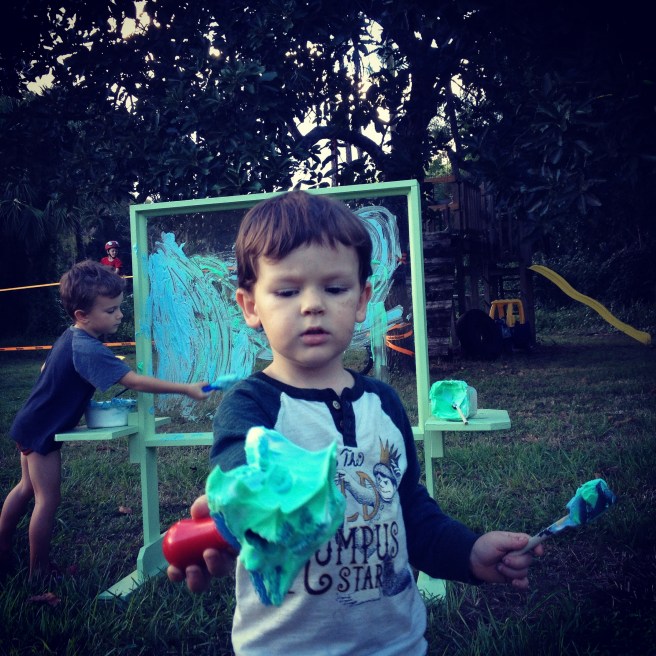
For me, Art is all about the E’s.

Expose, Encounter, Explore, Express, Emulate.
IMG_4982

Expose:
This is, somehow, the simplest and most difficult of all the steps. There has to be a purposeful step taken towards including quality art in your home. You have to go out of your way to bring it inside. You have to decide to mix it into your everyday life.
IMG_4983
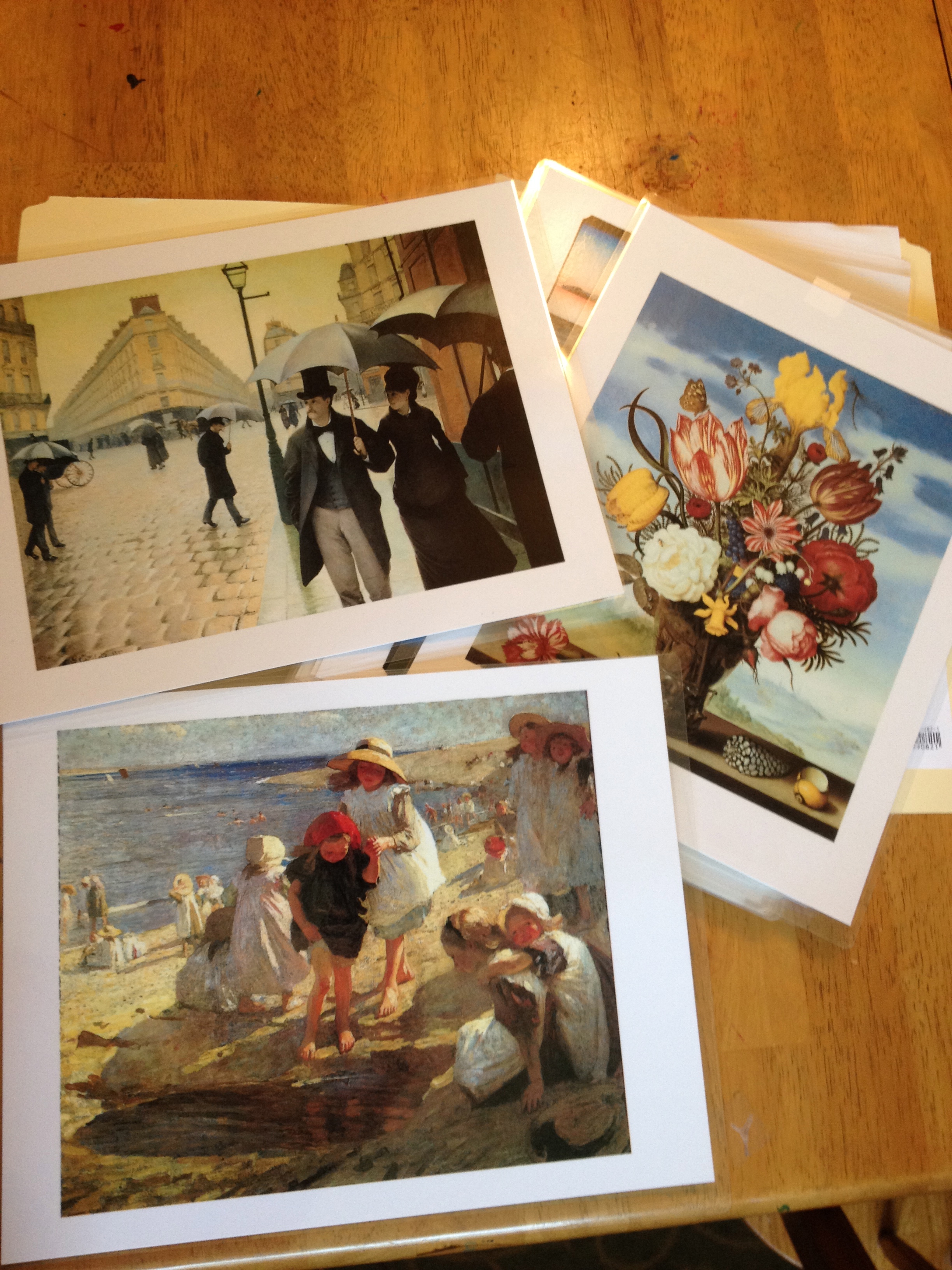
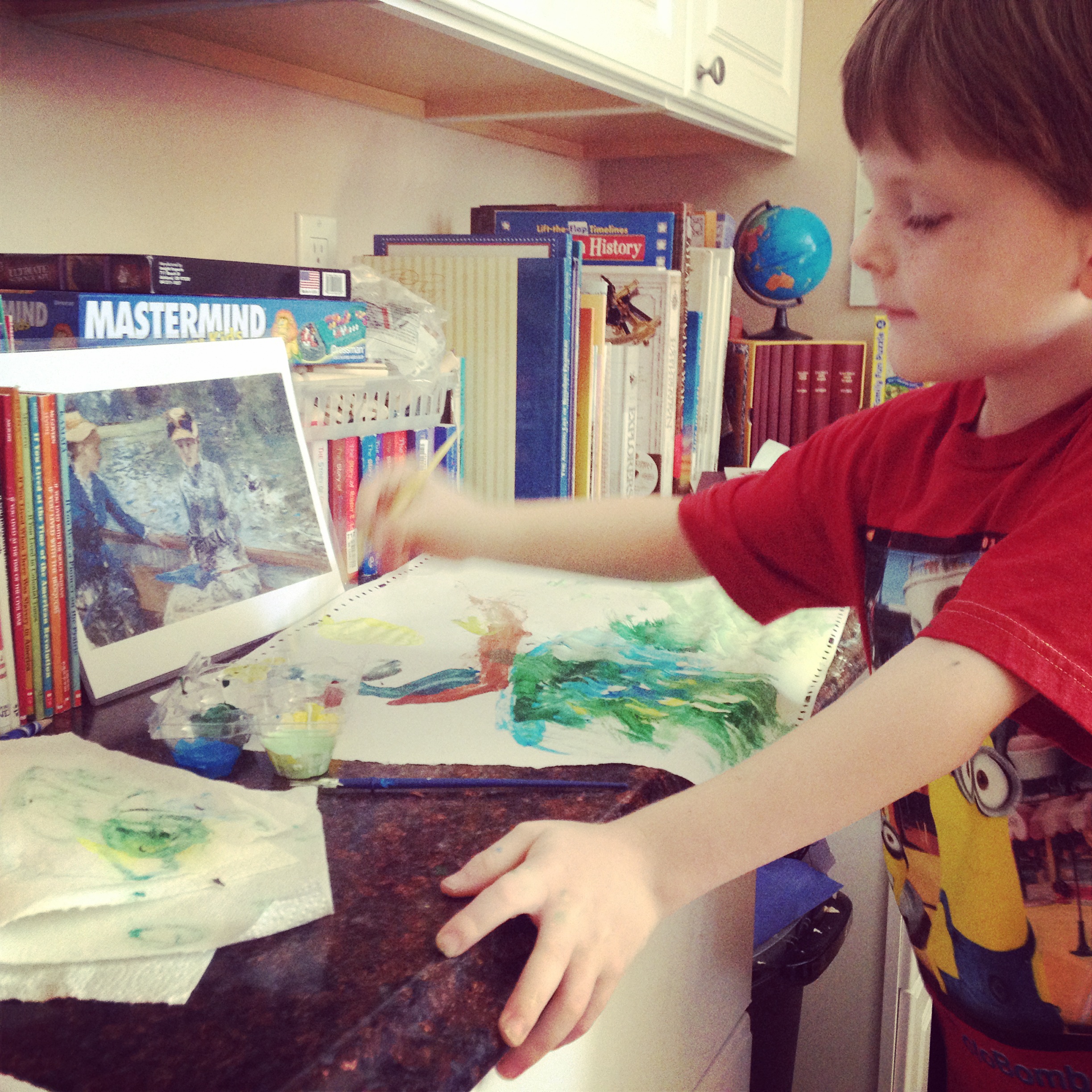
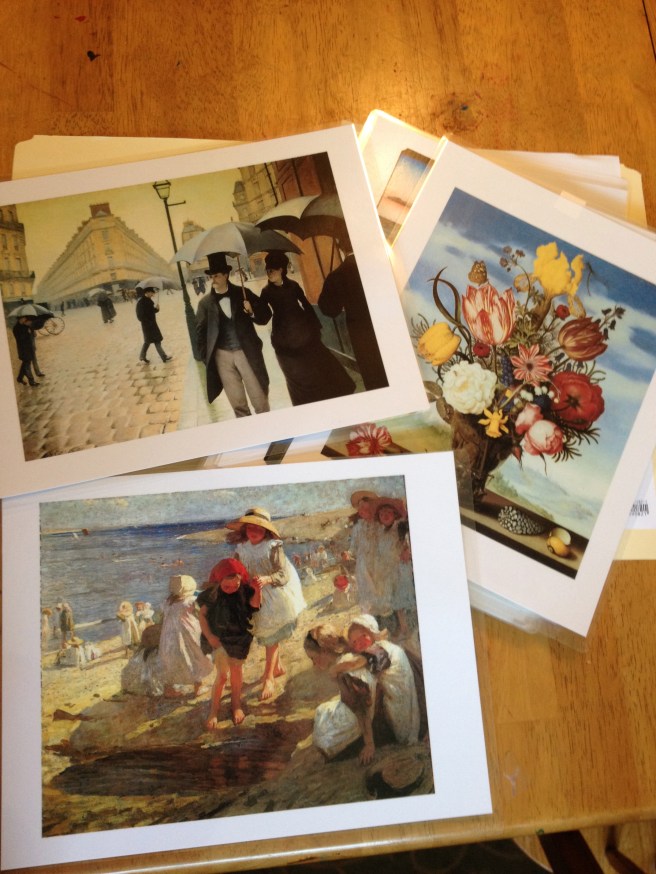
The paintings pictured above are part of an art study called, Enjoying Art Together, from My Father’s World. They helped me get the ball rolling back in the days of little to no quality art. I would hold up one painting before breakfast and lunch. I would not say a word. I would just hold it up and the kids would look at it. I would display it on the server next to our table between meals. I would leave the other paintings around the house where the kids would find them. Art books and puzzles started popping up around the house. Art sprang up around the home wherever the kids looked. They lived with art.
IMG_3706Encounter
Then I cracked open the books and read stories. My goal was to engage them with each painting. I started to ask questions, “What colors are used in this painting? How does that color make you feel? What are these people doing? Is it sunny where they are? How do you know?” Then they asked each other questions. They would look and look into a painting until they came up with a story about each one. Some stories were quite lovely, I will never forget my eldest son’s interpretation of Renoir’s “A girl with a watering can,” it was simple and heart achingly sweet. Nor will I forget my cheeky four year old’s story about Jackson Pollock’s “Blue Poles.”

“Forest made of spaghetti, my name is Blue and I DON’T like you. You show up on my plate on Thursdays and I wish you were tacos. Stop making me into blue forks, when all I want is to be free to love a taco.” 

Deep stuff, I know.

Surface value questions that lead to internal interpretation of what the artwork relates to them. That is pretty much the goal.

Explore
We start to look into how these pieces of art were made. I call their attention to certain elements. I slip in vocabulary words and touch on techniques. They repeat words back to me and then the new questions start. Michelangelo used marble? Where did it come from? How long did it take to haul out each piece? How long did he train to do this? What were his days like and how did that impact what he made? What other sculptures did he make? Do you have a favorite?

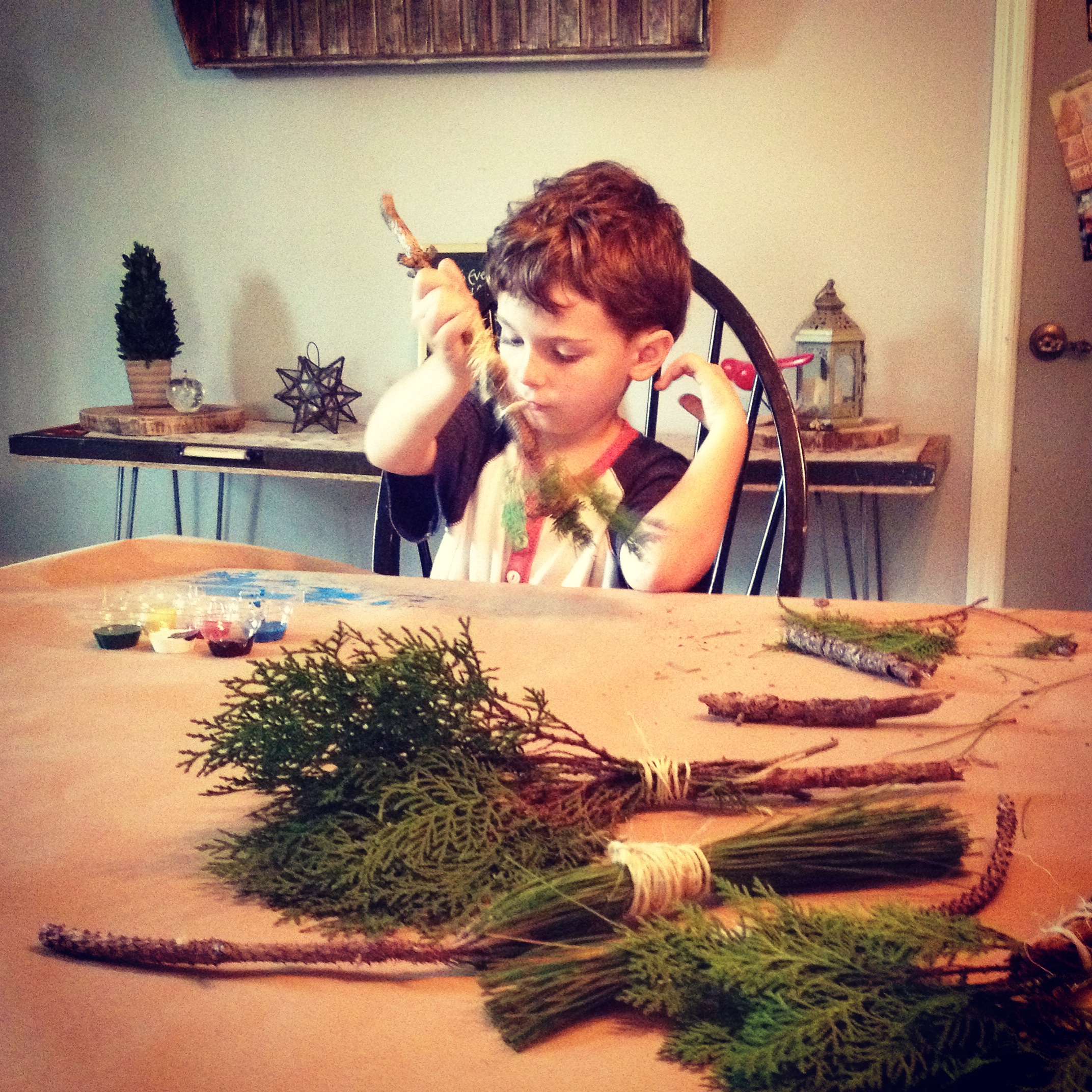
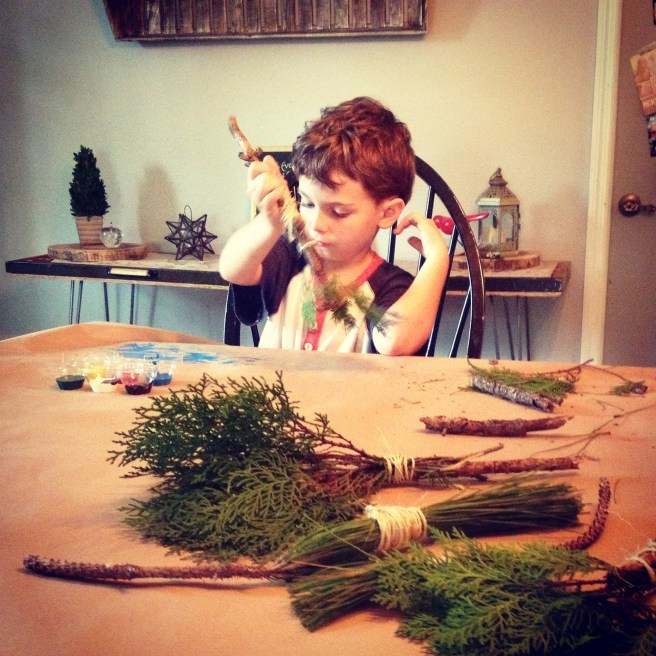
Lets think about these cave paintings. Where did all the different colors come from? What materials can we gather if we were to make this painting? Could we make this painting in another form? How would it look as a sculpture? watercolor? mixed media? The more artists and artwork we add to our vocabulary the more depth this step begins to have. For example, my seven year old choosing to paint triptychs based off of woodcuts from one of his favorite storybooks using brushes he made out of sticks and ferns from the back hollow. This idea sprang from a dozen sources and converged upon our dining room table one random rainy afternoon.
IMG_2973Express
Technically, they have been expressing all along! Their reaction to the initial art exposure, their questions and answers as they encountered art, their research and response as they explored the artwork. Now I gather all those balloons, tie them together, hand them over to my children and watch the lift off. This is the place where ideas and concepts mesh together and my children have the opportunity to express what they have learned. They talk about the odds and ends they have gathered and the different ways they employed each piece. This is probably my favorite portion of the process. We have moved from questions to conversation. Its a beautiful step and always takes the most unexpected shapes. In Classical education, every single subject is interconnected and it really shows when we reach this portion. Science, history, geography, math, language— all of it comes into play. Art and academics serve to enrich each other. Its rather thrilling. 🙂 IMG_4911Emulate
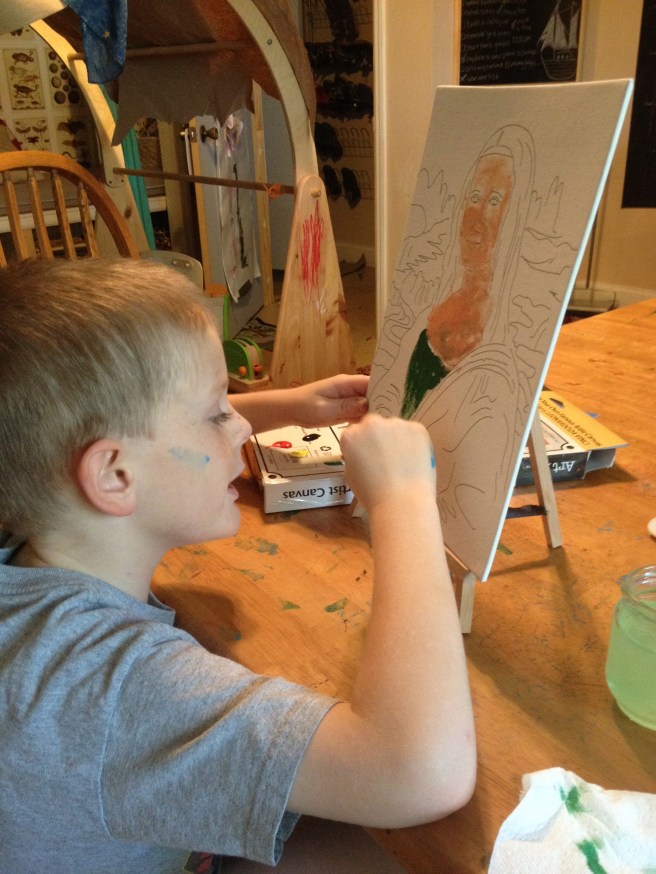
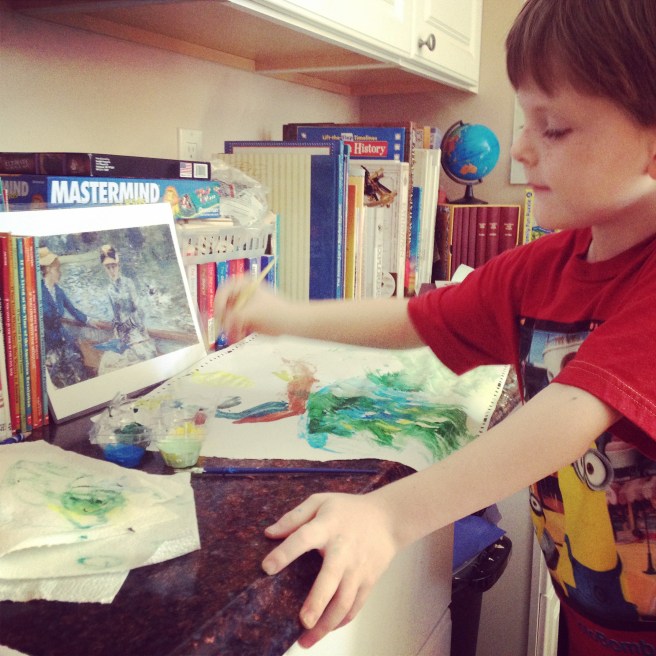
Now we go back to the beginning and look at the piece anew. I bring out texts or tools and we try and learn some techniques together. We recall the vocabulary we learned as we explored. We remember lines and shades and shapes we studied. Then we emulate what we have processed. It is easier to do this step after we have formed a friendship with the artist. We just had tea in a cozy Parisian cafe. Remember that crazy waiter who kept dropping the hot croissants? The night sounded like a lone trumpet and the breeze knew every hair on our heads. We can learn how to paint these elements now that we have spent days with them. Of course, it will never be the same breeze. It won’t be the exact waiter. We know this. We keep trying and we keep learning, and in our minds, we see the painting we want. We encourage our hands to keep trying.

Sometimes kids freak out when their art doesn’t match up to the idea in their minds. Sometimes I freak out too. But we are doing this together, the kids and I. The chances are high that at least one of us can talk the rest of the group away from the ledge of artistic despair. (So many FEELINGS in art class! Ay yi yi!) We remind each other, “Emulate might look more like an Echo, for now.” (or forever, in my case). Art is not a perfectly executed machine. I don’t ask for or require perfection. Art is chance to demonstrate what they have learned and showcase their experience with it. The children’s Matisse renditions looked nothing like Matisse, but they felt like Matisse.

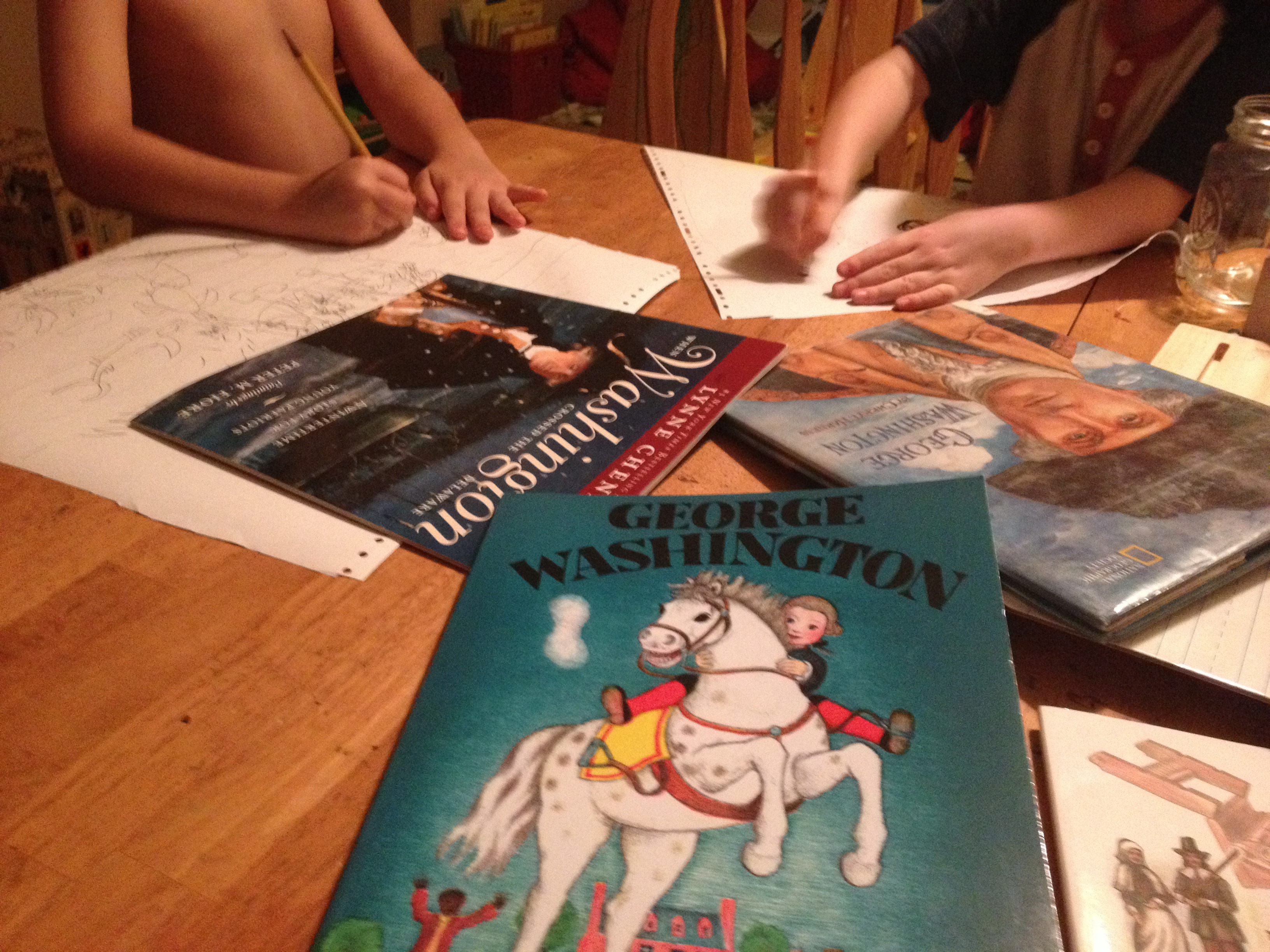
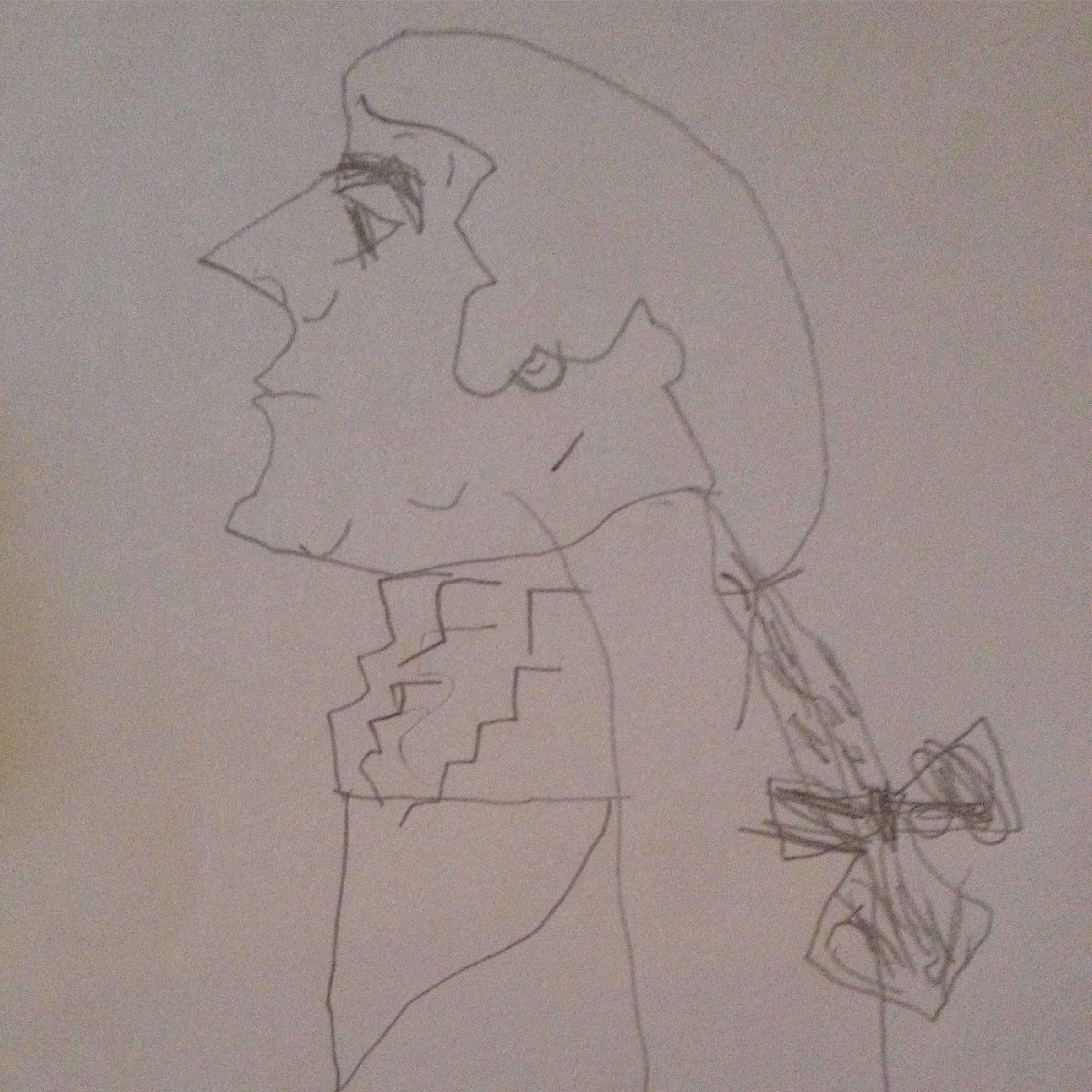
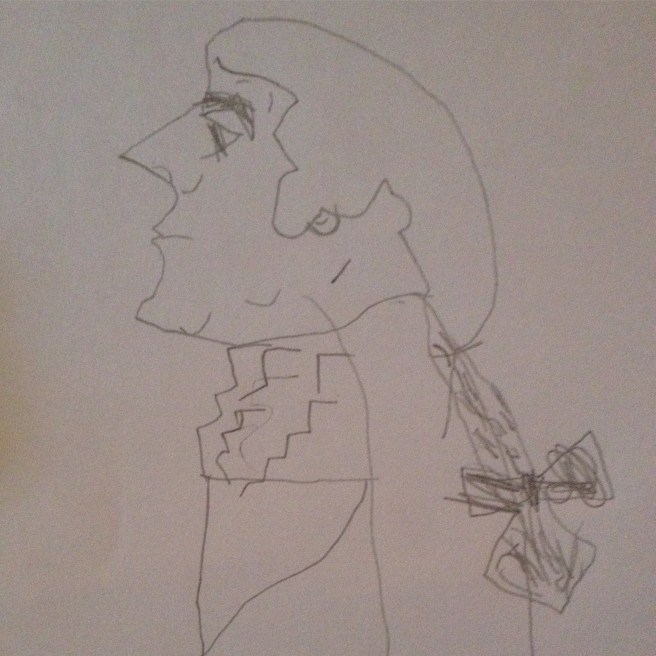
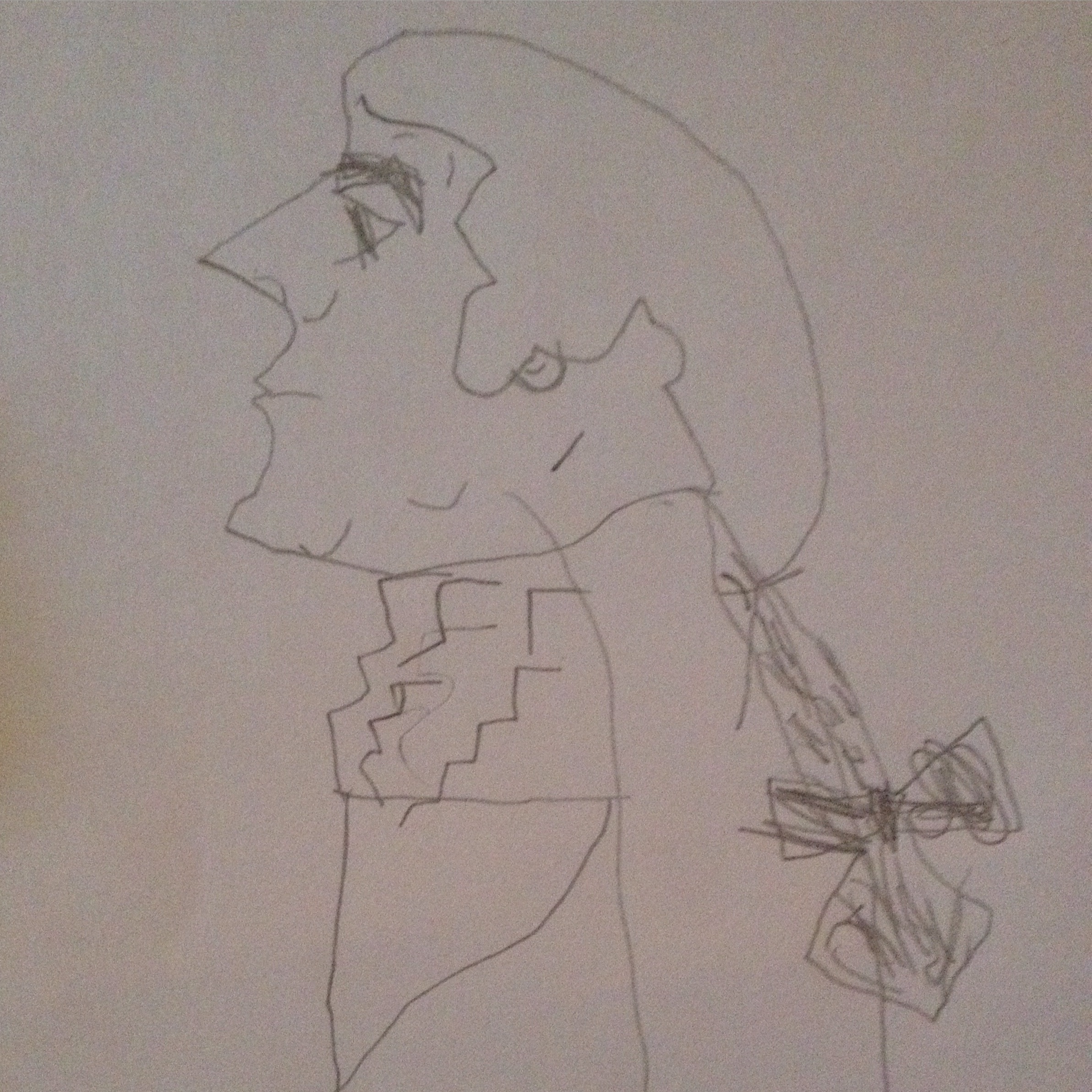
My eldest hated drawing for the longest time. But he persevered and continued to work hard. A few months ago, he drew this picture of his hero, George Washington.
IMG_5623
Technique may not be perfect, but art has seeped into their pores and mingled with their thoughts and become impressed upon their cellular memory as they paint, mold, sculpt, paste, splatter and create.

Posts like this make me nervous. Don’t read perfection. Don’t think I have it all figured out. With four kids in the mix, we rarely have an art session that does not include tears or disappointment of some kind. Find a way to let art find its way into your home. Whatever that looks like for your family, just take the first step because it is a beautiful, valuable element of education that should not be overlooked.
IMG_3033


Farmhouse Schoolhouse Favorite Art Resources

Websites~
Donna Young: the whole site is full of ideas for various subjects. Donna’s art tab has great projects and directions for learning drawing techniques and perspectives. Very helpful!
Art History Mom: I really dig this site. Art History Mom has tons of project ideas based off of various famous pieces of art. We loved her Van Gogh Sunflower art project.
The Artful Parent: Pretty much everything in this site is great. “Simple ways to fill your family’s life with art & creativity.” Yes, please.
Filth Wizardry: Discovered this gem thanks to The Homegrown Preschooler. Messy art for kids. Huzzah!  #sayyes!
Jackson Pollock Painting Center: it comes up as a blank site. As you drag your cursor the lines appear and once you click it will switch over to a new color. No ads, no weird pop ups, just painting Pollock style. The tots LOVE this and I love it!
Picasso Head: Make Picasso heads with clip art. So much fun.
National Art Gallery for Kids: There is so much on this site, I don’t even know where to start. Check it out. My kids made a gorgeous landscape a few weeks ago using this site. It was really fun to watch unfold.

Art Studies~
Simply Charlotte Mason’s Picture Study Portfolio
My Father’s World Enjoying Art Together
Memoria Press Art Cards 
Drawing with Children by Mona Brookes

Book List~
Katie and the Picture Show by James Mayhew (Adorable little Katie visits Museums, crawls into pictures and goes on adventures. We love every. single. one.)
Katie and the Starry Night by James Mayhew
Katie and the Sunflowers by James Mayhew
Katie and the Bathers by James Mayhew
Katie Meets the Impressionists by James Mayhew
Katie and the Waterlily Pond by James Mayhew
Katie and the Spanish Princess by James Mayhew
Katie and the Mona Lisa by James Mayhew
Anholt’s Artists Books for Children by Laurence Anholt: This is a great series! We love “The Magical Garden of Claude Monet”
Getting to Know the World’s Greatest Artists:  Another great series by Mike Venezia. Your local library may even have some DVDs. Our boys adore Venezia’s story about Michelangelo.
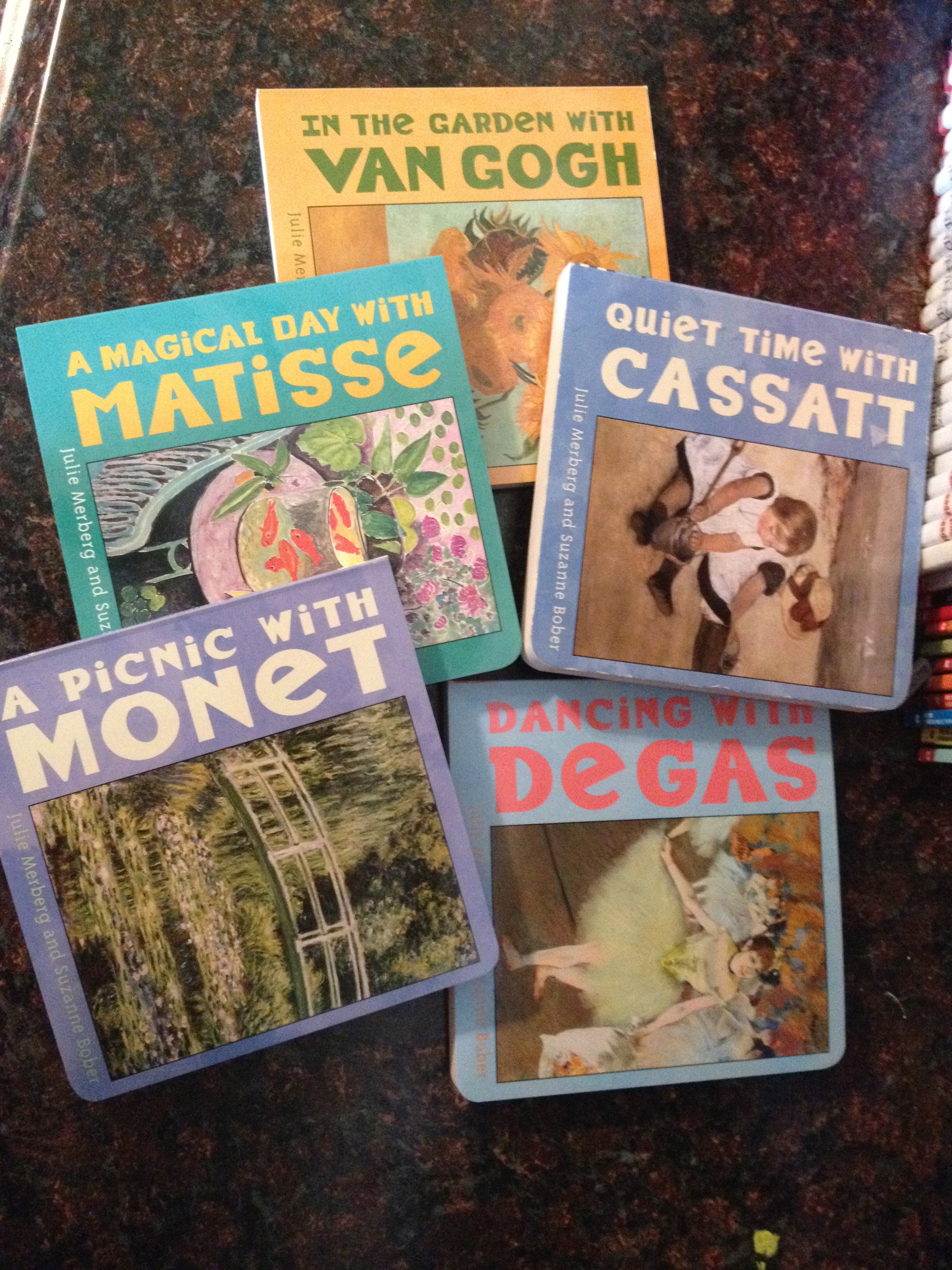
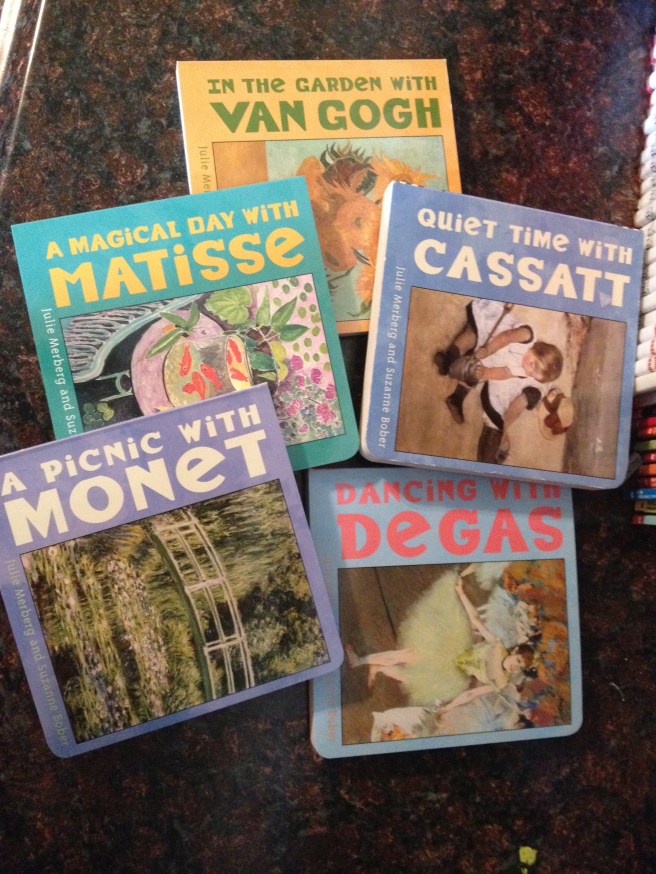
Mini Masters Boardbooks: A series for toddlers. We love these. They have gotten really really pricey. I’m talking $40 on amazon for the Monet one. We found ours as a bundle on ebay. These are definitely cute but I wouldn’t break the bank to get them.
Henri Matisse: Drawing with Scissors by Jane O’Conner
Vincent Van Gogh: Sunflowers and Swirly Stars by Joan Holub
Pablo Picasso: Breaking All the Rules by True Kelley
Tickle Tut’s Toes by Julie Appel
Make Van Gogh’s Bed by Julie Appel
Count Monet’s Lillies by Julie Appel
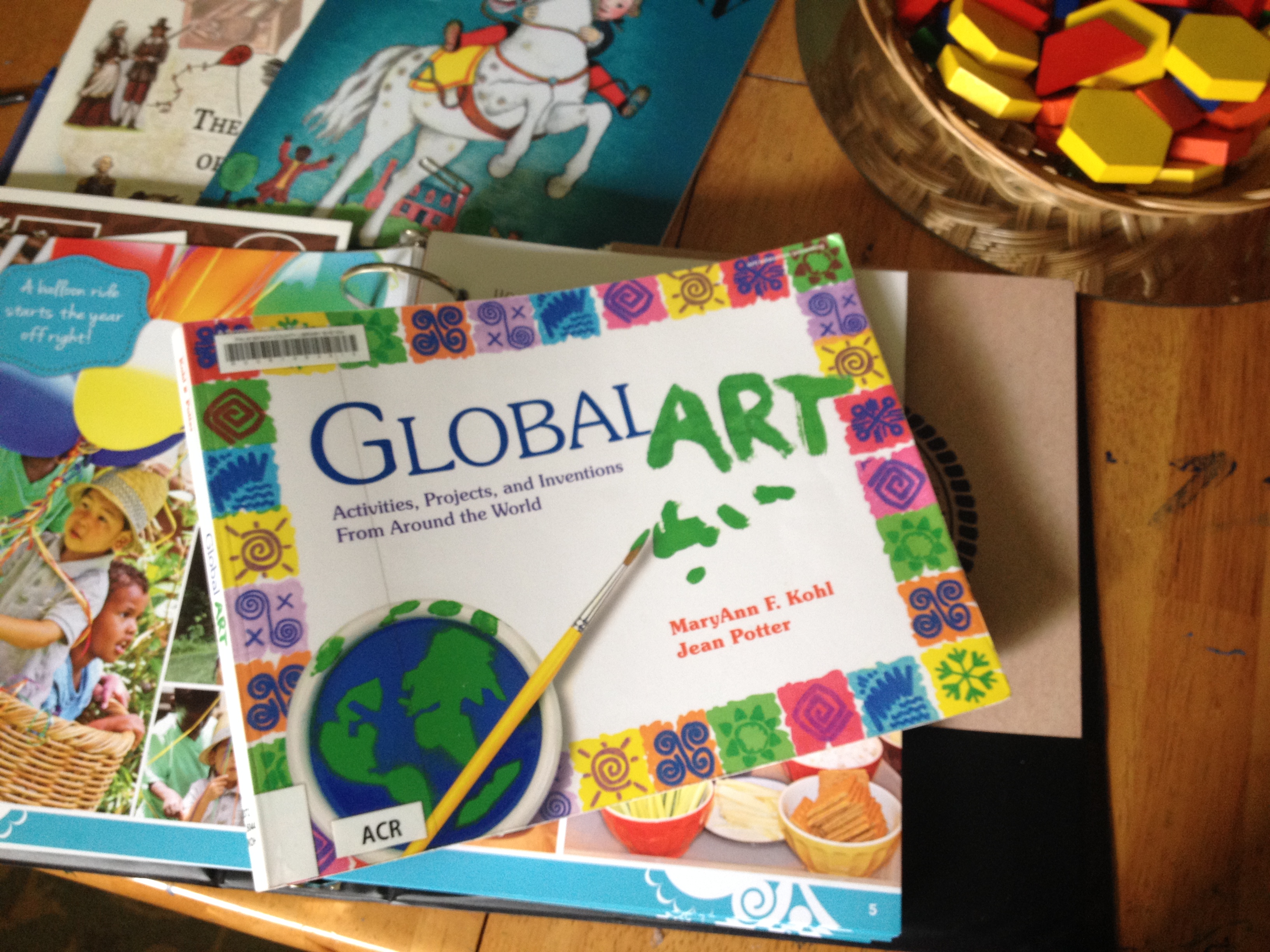
Maryann F. Kohl has fantastic art books! We have about 10 of them. We have found them for pennies at thrift stores and on used book sites. Global Art, Story Art and Discovering Great Artists are some of our favorites.
A Child’s Book of Art by Lucy Micklethwait
ANY COFFEE TABLE BOOK WITH GIANT PICTURES OF ART. Truly, get thee to a Barnes & Nobles and check out that huge clearance section of books. There is almost always a giant collection of art that you can buy for around $5. Its usually tucked behind “Weapons of the Civil War” and “Haunting Visions of Ireland.” Pictures. of. art. Go!
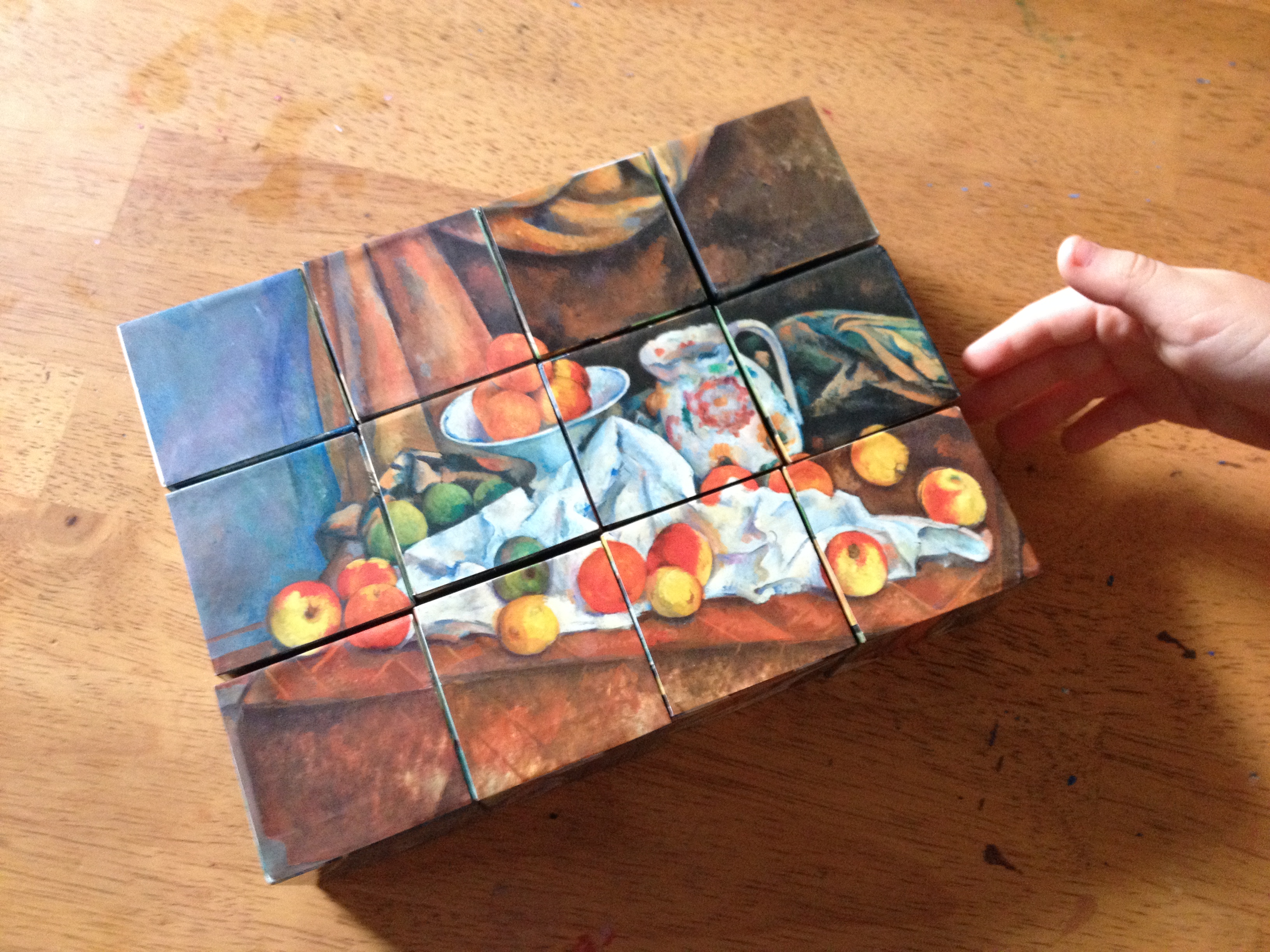
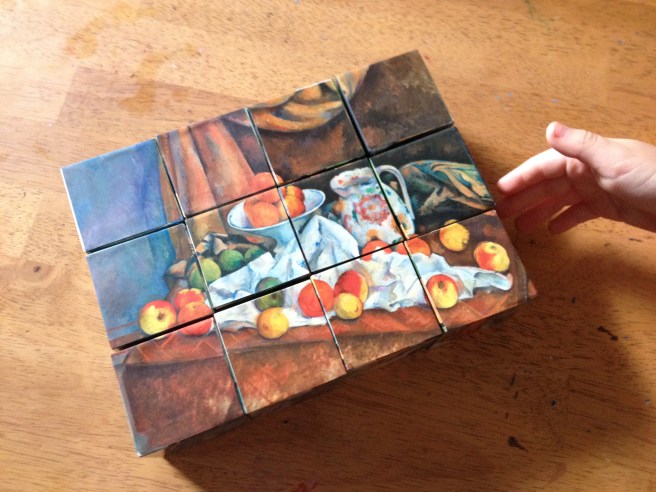
Paul Cezanne Block Puzzle: I know its not a book, but this one is too good not to share. Six paintings, one puzzle, big chunky blocks. We love ours.

Art Supplies typically not listed on other blogs~
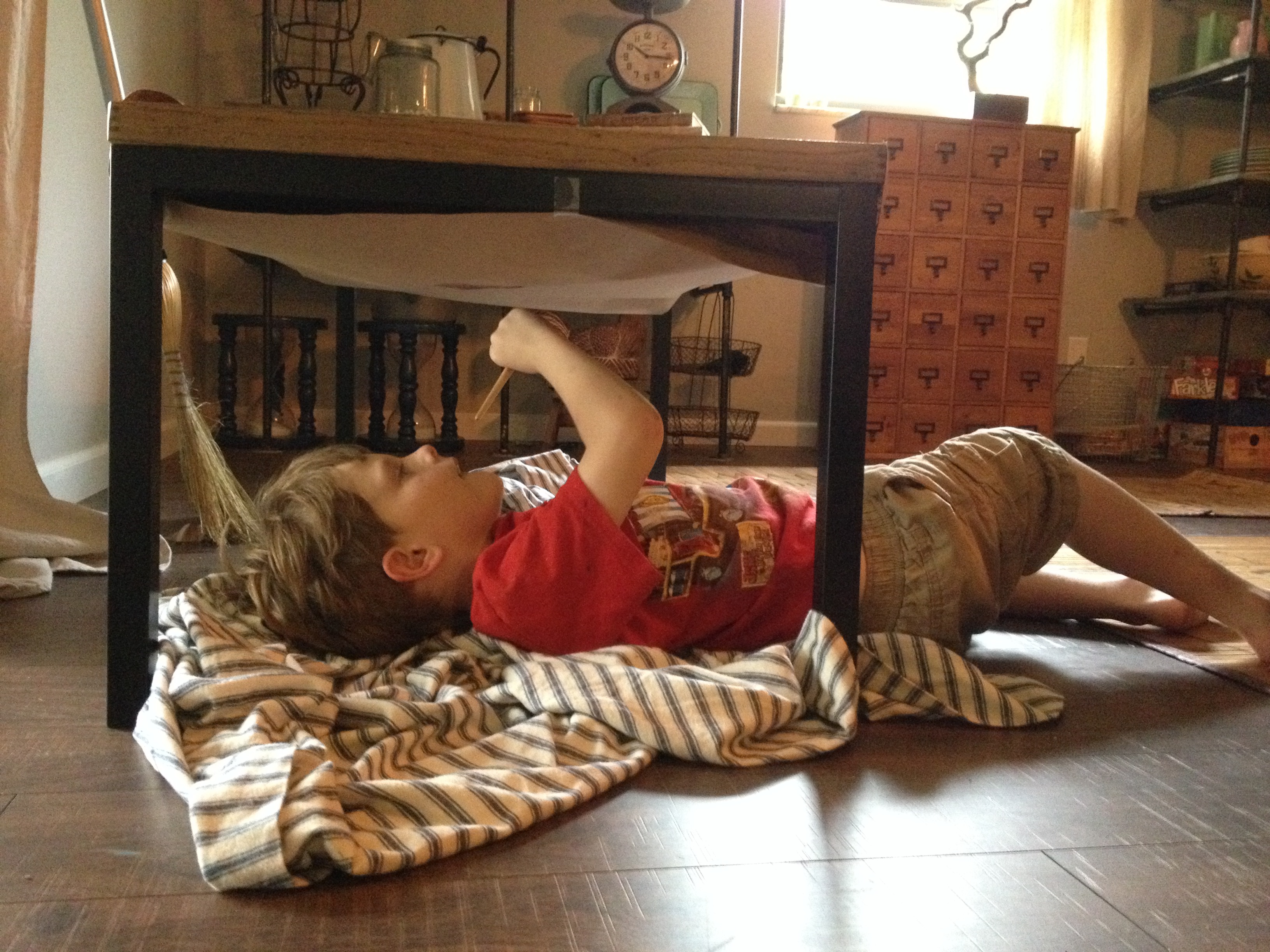
Kraft Paper Rolls: I’m talking the ginormous 1000 ft rolls. They last a good year and a half or so and we use it every week. I just unroll enough to cover the table, cut and the kids can paint and practice new techniques or make a huge mural.
Plastic Egg Cartons: Yup. Ask your family to save them for you. Cut them apart so you have trays with six slots each. These are cheap, disposable paint palettes.
Twine: We use a surprising amount of twine. Mostly because the boys love making their own paintbrushes thanks to “Benjamin West and his Cat Grimalkin” by Marguerite Henry. (Story of American painter Benjamin West who grew up in a Quaker home, no art allowed, and made paint brushes out of his cat’s hair). We use the twine to bundle up pine needles or grass blades to sticks for a natural paint brush.
Vegetable/Fruit Scraps: Don’t throw that celery butt away. Hand it to your toddler to make celery stamps while you are teaching your older kids the basics of drawing. Keep those moldy strawberries and squish the juice out of them to make paint.
Grocery bags: Its not a bag anymore. Its a smock. Paper or plastic—it will work.
Standing Mirror: For self portraits.
Chocolate: For despair.
A camera: For documenting your child’s artwork and progress!

MFW Adventures: Revolution & Rhinovirus

The best time to gauge my children’s progress in learning to work independently, always occurs when I am sick.

Mom is down for the count. How much can you do on your own?

I’ve been working hard with my eldest son to learn how to fend for himself. Last year, I realized that if I ever disappeared for a few days, I would likely return to find him half starved and wearing the same clothes he had on when I left, with a decent chance he may not have even noticed my absence. The child knows how to melt away into imaginative play like no other. On the other hand, my second born would have prepared three square meals a day, finished a load of laundry, completed an assortment of projects on top of his daily schoolwork, and managed to keep all the pets fed and the house clean.

Its not like I only worked with the second born on life skills. They both received the same lessons and the same amount of attention. It really boils down to this: my second born cares about independence and basic hygiene; my first born does not care about anything but the alternate universe in his head.

So I end up sick for their all time favorite history topic, the American Revolutionary War.  What to do? Should I skip school for a week? If it had been any other subject, I would have! But here was a chance to see the kids in action in a subject they were well versed in.

I did decide to skip science this week as an act of grace and mercy towards myself. We voted to double up on science the following week.  We kept our morning routine the same. The boys worked through their Saxon lessons and we set aside our Language Arts for the week. When life gets hard we usually stick with one or two subjects and let the other subjects take a rest. The chances of goal achievement are much higher and I don’t have to deal with the horrible guilt of not finishing a tremendous to-do list by the end of the week. Honestly, stripping back also helps the kids learn much more than they do when I try to pack in too much. Win-win.

IMG_6006

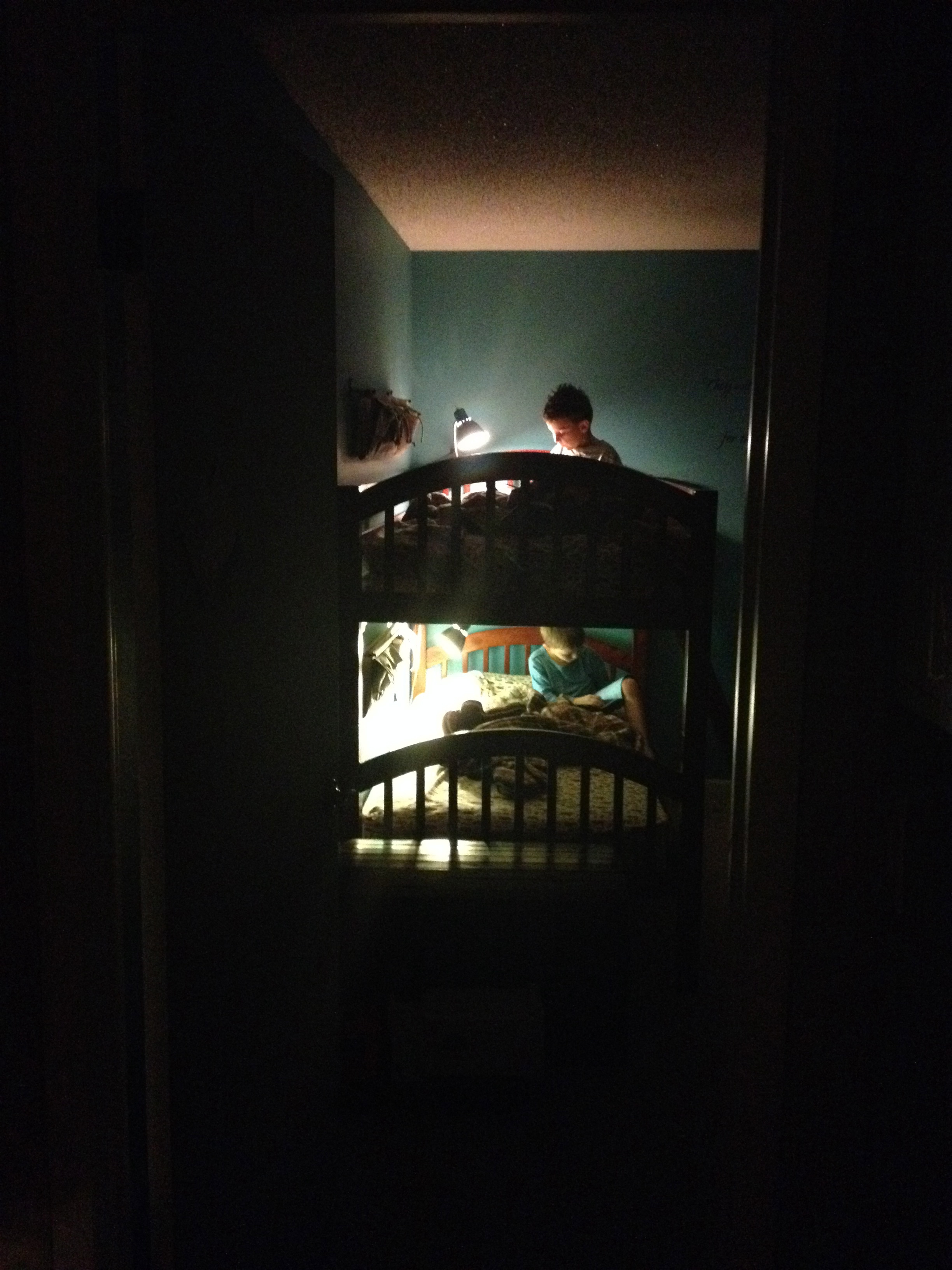
So how did we survive the Revolutionary War while the General battled Rhinovirus? Well, aside from an insane “Liberty’s Kids” marathon that has left me with a vehement hatred for the opening bars of “I see a laaaaaannnnnd….,” we spent the majority of our days on the floor with packs of army men and an assortment of legos.  I read books aloud and drank tea. Whenever I needed to sleep, they read books to each other and drank tea. Even outside of school hours, the boys kept picking up easy readers and step into reading books about the Revolution.  I loved passing by their room at night and seeing those night lights on and the history books open. What a thrill!  Despite the hideous plague of illness I was wallowing in, I could not help but feel immense gratitude for the blessing of homeschooling. My kids don’t hate school. They love to learn. <—This will never cease to amaze me!

IMG_5984

The boys built a variety of weaponry. Cannons, sabers, muskets. Full disclosure: I did not teach them any of this, I don’t know where they acquired this knowledge and I still have no idea what any of it is , how it works, or when it was used. I only know that my kids dig it big time.

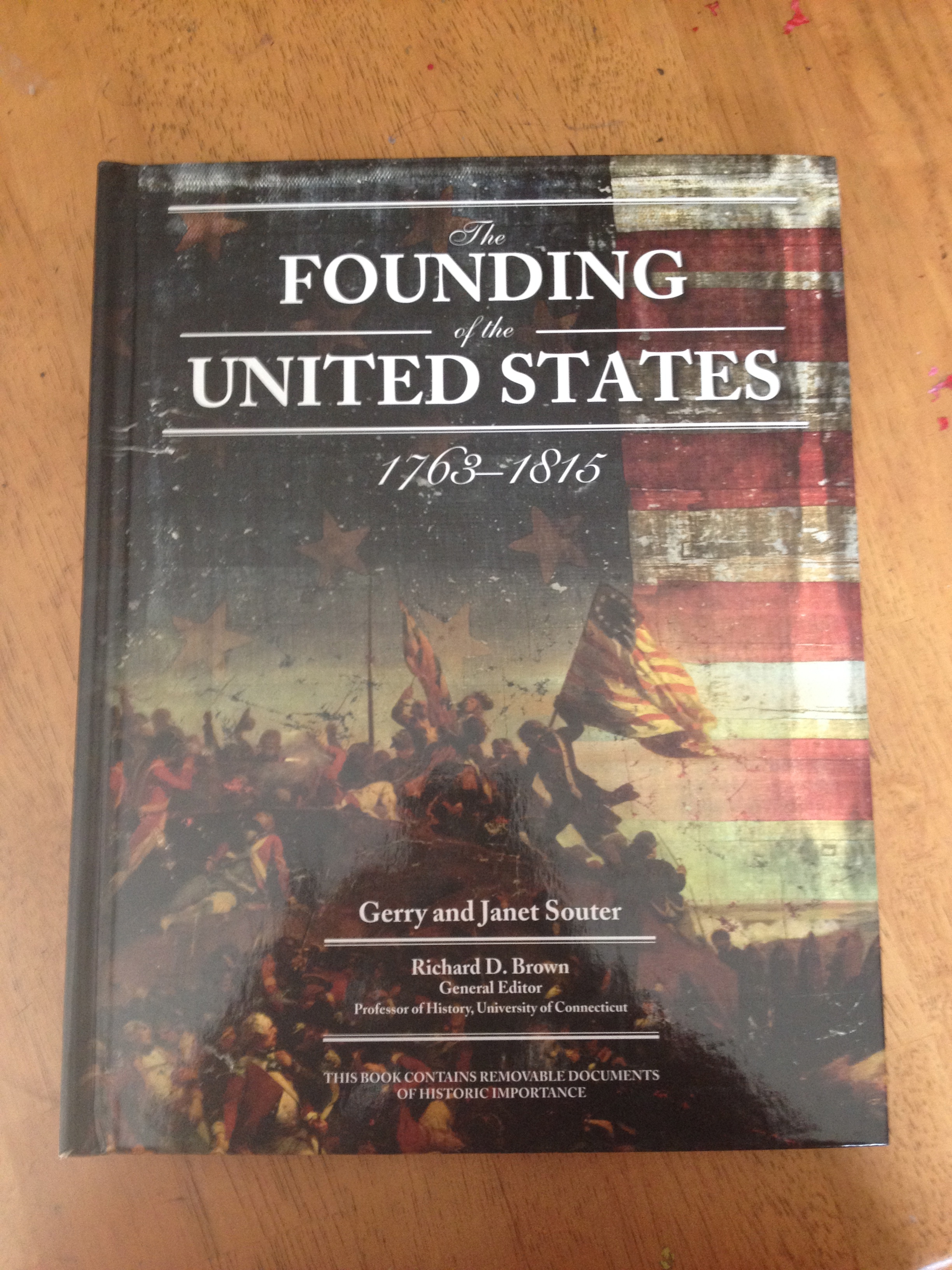
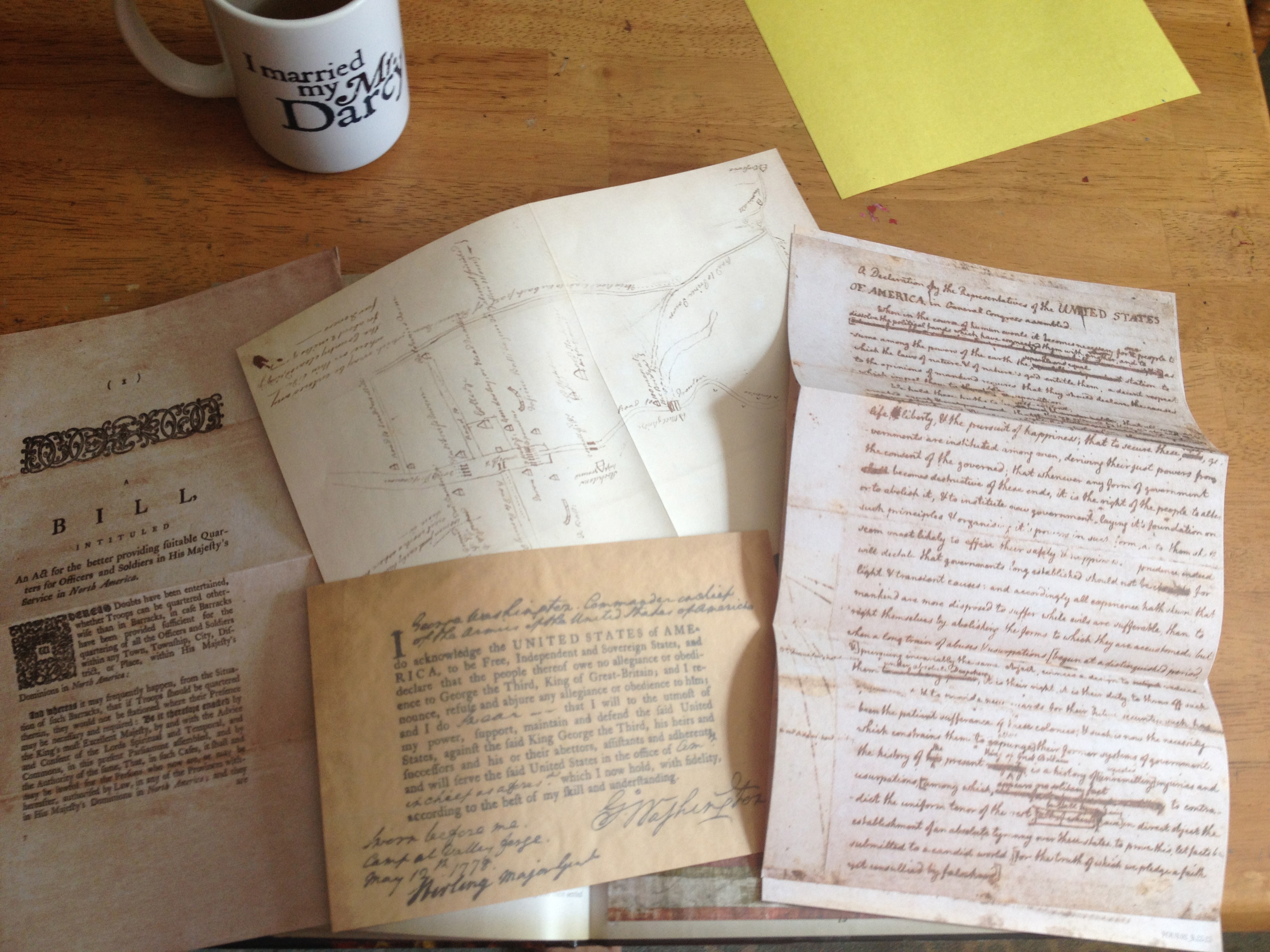
A few months ago, I stopped off at a Barnes & Nobles with $7 left on an old gift card. I found this book in the clearance section. Totally NOT age appropriate, however, it came with dozens and dozens of document replicas that made its $5 price tag worthy of my gift card.

IMG_5980

IMG_5981

IMG_5982

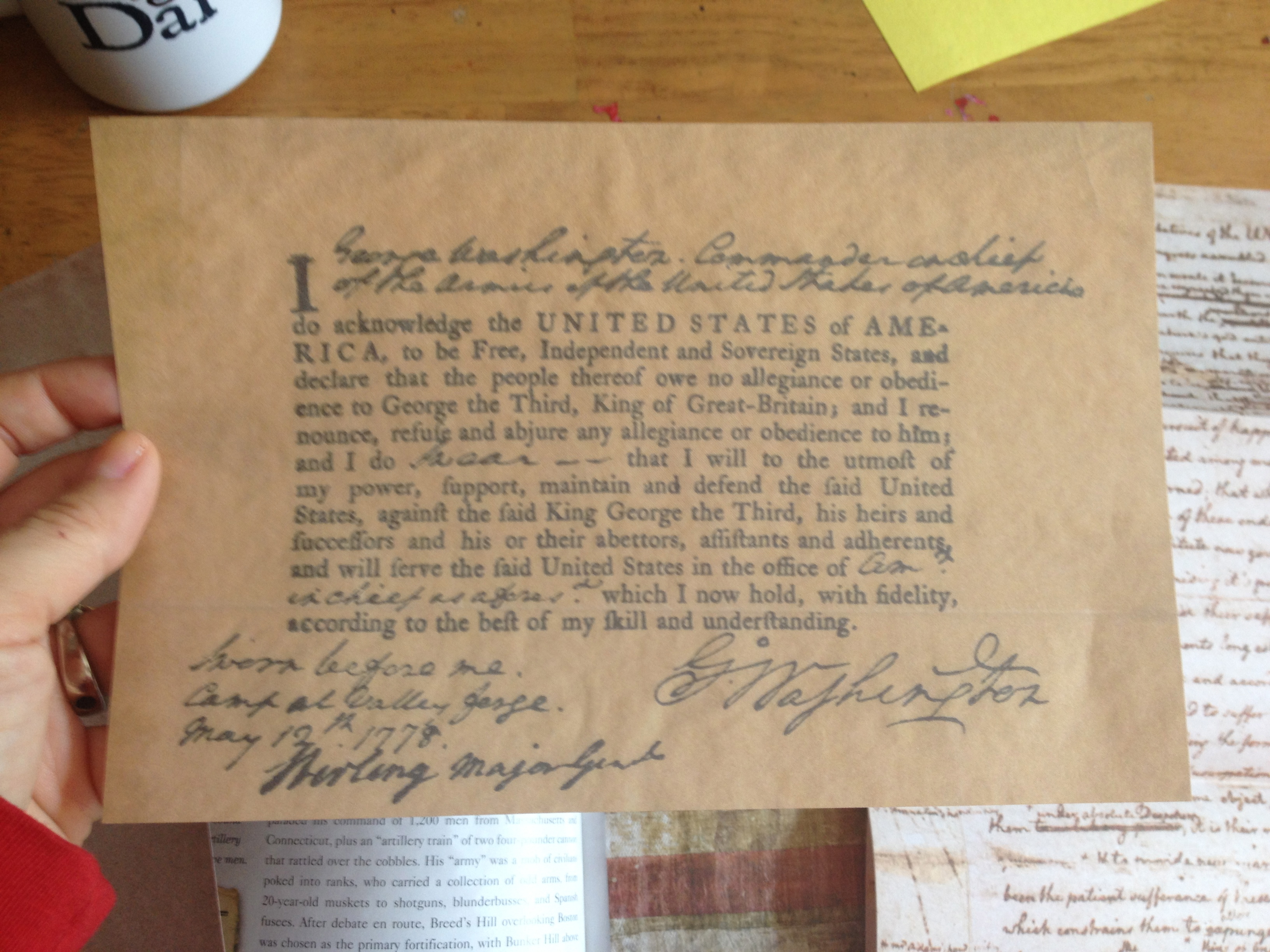
The boys loved reading notes from Cornwallis, drafts of the Constitution and George Washington’s commission note which renounces his allegiance to King George and pledges his loyalty to the United States.  Lots of tiny people geeing out over here. They spent Friday in Revolutionary War garb, tricorn hats in place, sending missives back and forth between camps. The toddler Nathan Hale was usually charged with carrying the documents between the Greenback Mountain Boys and an “ICY COLD” General George Washington.

So what did we read this week? Pretty much everything by Jean Fritz. One lunch hour consisted of twelve books and many, many quesadillas with sliced avocados from our tree. (Lemon tea for me!) They did not want lunchtime reading to end.

IMG_5977

Revolutionary War Book List
Can’t You Make Them Behave King George? by Jean Fritz
And Then What Happened, Paul Revere? by Jean Fritz
Shh! We’re Writing the Constitution by Jean Fritz
Where was Patrick Henry on the 29th of May? by Jean Fritz
Why Don’t You get a Horse, Sam Adams? by Jean Fritz
The Cabin Faced West by Jean Fritz
Why Not, Lafayette? by Jean Fritz
Will You Sign Here, John Hancock? by Jean Fritz
The Scarlett Stocking Spy by  Trinka Hanks Noble
The 18 Penny Goose by Sally M Walker
George the Drummer Boy by Nathaniel Benchley
If You Lived at the Time of the American Revolution by Kay Moore
If You Were There When They Signed the Constitution by Elizabeth Levy
Heroes of the Revolution by David A Adler
Nathan Hale Patriot Spy by Shannon Zemlicka
Paul Revere by Esther Forbes

We capped off the week with a Revolutionary battle reenactment that resulted in three nosebleeds, one broken picture frame, a box of overturned cheerios, a damaged tricorn hat and left me bedridden until my sweet husband came home early from work to rescue me.

Confession: I have a super big crush on my children’s principal.

MFW Adventures: George Washington + Bribery

Last Spring I sat at my desk and pulled out my new planner. I wrote out all the things we would be doing in the fall and felt tired just writing it all down.

IMG_5774
A few weeks later I trotted off to the FPEA convention and had a rather eloquent kick in the butt from Sonya Schafer of Simply Charlotte Mason. I went home and stripped my schedule down to the bare bones—and it was still overwhelming.

So I made the decision to start Adventures months earlier than I had initially planned. Early enough to get in at least 10 weeks of school before Classical Conversations, A Year of Skillful Playing, therapy and sports all took off in late August/early September.

IMG_5771

I am so grateful for that decision!

IMG_5653

We spread our unit on George Washington out over two weeks. In that course of time, Classical Conversations began and our in home therapy sessions started for our youngest boy. Next week, our year with Homegrown Preschooler starts. (Check back for updates!) Its somehow easier to add extras into an already established routine. The boys were eager to add new things in while still adhering to our established rhythm with Adventures. Real life seems a bit more manageable this year! I may have to repeat this schedule for Exploring Countries & Cultures. I always have to remind myself to take advantage of the freedom that comes with homeschooling.

Here is the breakdown on Adventures Week 9: GEORGE WASHINGTON!

(disclaimer) My eldest son is OBSESSED with GW. For his 7th birthday, our entire family dressed up like different Revolutionary war heroes and we spent the morning reenacting different battle scenes. He wanted a GW tshirt and a documentary for his birthday.  I knew we needed to spend a few weeks on ol’ George so the booklist is hefty!
IMG_5775

Activities:
1) Land Survey
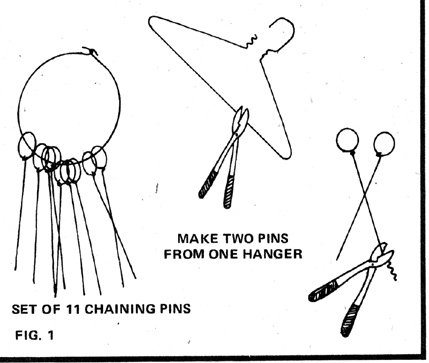
Mother Earth News provides a very detailed explanation on how to survey your own land. I was not really up for going all out on this one. I just wanted to give the kids a basic idea of what a teenaged George Washington did to earn his bread and butter.  Our homestead is 2.5 acres, flat as a pancake. We made the chaining pins and used a piece of yarn to get our level measurements. It was 92 degrees and we received approx 18 mosquito bites between 5 people in the span of twenty minutes.  The boys were thrilled!

motherearthnews.com
motherearthnews.com

2. Indian Hoecakes
Based off one of our booklist treasures, “George Washington’s Breakfast” by Jean Fritz. The boys begged me to cook these little cakes outside in the fire pit on an actual hoe. I was pretty close to complying until I imagined my exhausted husband shaking his weary head and asking, “Sooo how exactly did the fire that ravaged our entire home start?” We stuck to our stove and a regular ol’ frying pan.

3. Fort Necessity
I am so sad I didn’t snap a picture of this activity. The boys built an enormous blanket and pillow fort and had a blast all day inside. We brought in a lantern and knocked 6 books off our list in one afternoon. There was a massive thunderstorm outside which made the fort an extra cozy haven for us.

4. Unsanctioned crossing of the Delaware
I managed to get my two youngest children down for a nap last week. After a night of little rest, I asked the older kids to build legos while I took a quick nap. Whenever my eldest children are left to their own devices, unexpected things happen. Thankfully, the firstborn develops ulcers at the mere whisper of anything unsafe, so I can rest easy. It may be unexpected, but it won’t be dangerous. I woke up 30 minutes later to find the boys floating toy boats filled with soldiers in a bathtub filled with water and ice. I never ever would have thought to do such an activity. They adored it.

Book List for George Washington Unit

  1. Benjamin West and his Cat Grimalkin by Marguerite Henry. (Part of our Beautiful Feet book study)
  2. George Washington’s Breakfast by Jean Fritz
  3. Phoebe and the Spy by Judith Griffin
  4. George Washington by Ingri D’aulaire
  5. A Picture Book of George Washington by David A. Adler
  6. A Picture Book of Patrick Henry by David A. Adler
  7. Journey to Monticello by James E. Knight
  8. The Winter at Valley Forge by James E Knight
  9. When Washington Crossed the Delaware by James E Knight
  10. The Cabin Faced West by Jean Fritz
  11. George Washington’s World by Genevieve Foster
    ***This book was given to us by another homeschool family. I don’t recommend it for younger children as a stand alone read. Its basically a text book about the world during the time of George Washington. My son is always asking  “what else was happening in the world?” whenever we study something (Thanks, Classical Conversations!) and so he loved flipping through this book.
  12. George vs George: The American Revolution as seen from Both Sides by Rosalyn Schanzer
  13. Paul Revere’s Ride by Henry Wadsworth Longfellow
  14. Sybil Ludington’s Midnight Ride by Marsha Amstel
  15. The Story of George Washington by Patricia A. Pingry (board book for littles)
  16. George Washington and the General’s dog by Frank Murphy
  17. George Washington: Our First Leader by Augusta Stevenson
  18. Pauk Revere: Boston Patriot by Augusta Stevenson
  19. Who was Paul Revere? by Roberta Edwards
  20. Sarah Witcher’s Story by Elizabeth Yates
  21. George Washington by Cheryl Harness
    IMG_5167Additional Resources1.  Jim Weiss
    We love Jim Weiss. We started collecting his stories last year and they are the most requested stories for the CD player each night. For this unit, we enjoyed George Washington: First in the Hearts of his Countrymen. 
    2. Drive Thru History
    3. For God and Country- Adventures in OdysseyI know—its a huge booklist.But like I said, my kid is a BIG FAN of all things George. The truth is, all these books were one big candy incentive to get my eldest boy motivated to do some ART! And boy did we ever have time to do artwork! Renderings of George as land surveyor, Farmer Washington, Major Washington, General Washington and President of the United States, are now littering the classroom along with a dozen or so gruesome battle scenes. (We are binding all the drawings into one large book for the two boys to enjoy) Before each reading session I would set out basic art supplies and we would spend ten minutes discussing our OiLS concepts from Classical Conversations. Then the boys would begin to draw. We’d stop every few chapters to look at work and discuss what they would be attempting next.

    It worked! It worked so well. No complaining whatsoever. Glory be!

    “Please Mom, read another story and we’ll do more art work.” Music to my ears. I won’t flood my post with pictures of artwork, but I will post one that I am very proud of; my eldest son’s drawing entitled, “Portrait of Reluctant George.” I asked him why he named it that and he responded, “Poor George just wanted to be a farmer after all that fighting. Then they went and made him President!”IMG_5623
    Woo-hoo! Something that is not a stick figure. SUCCESS.

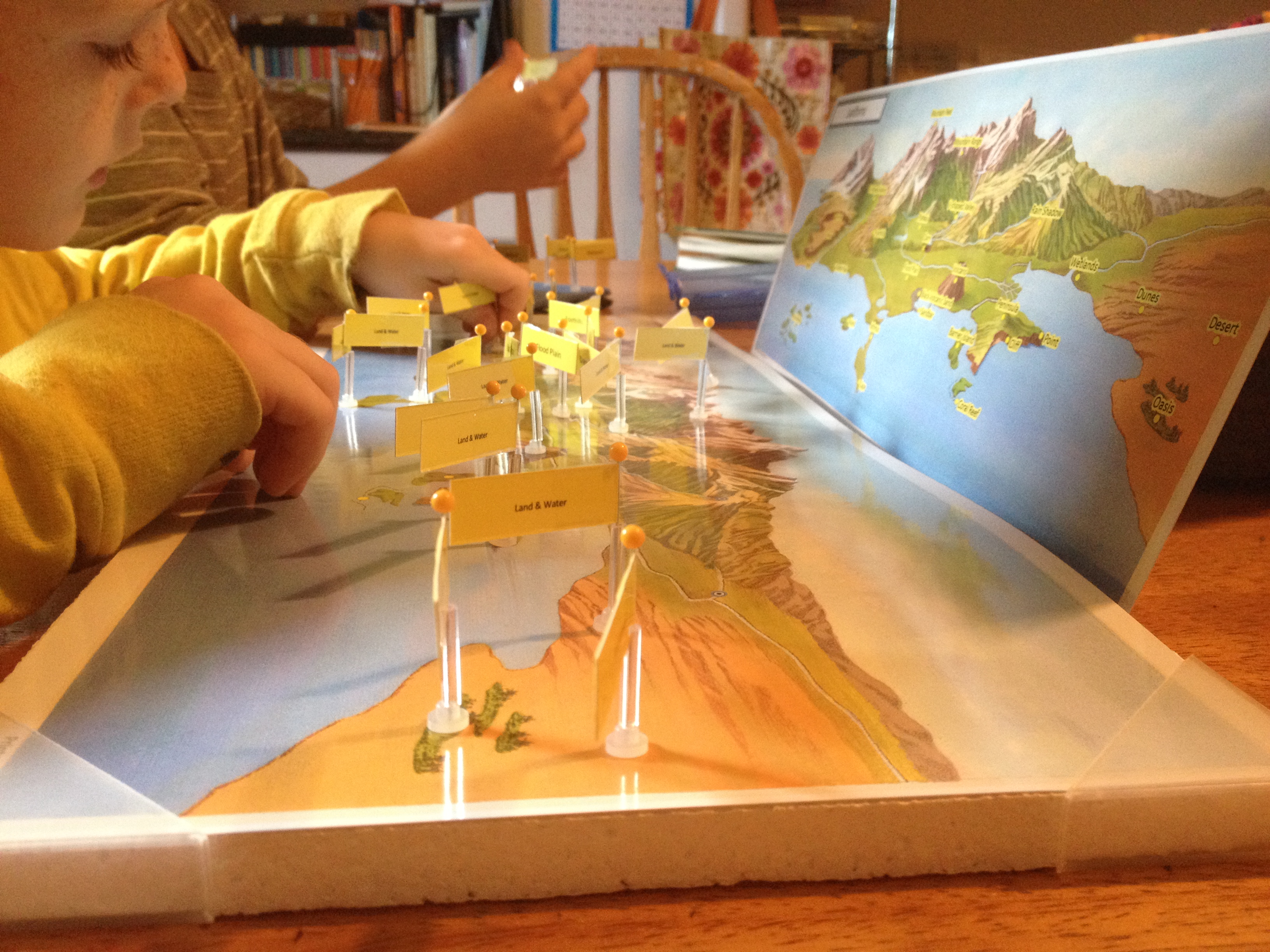
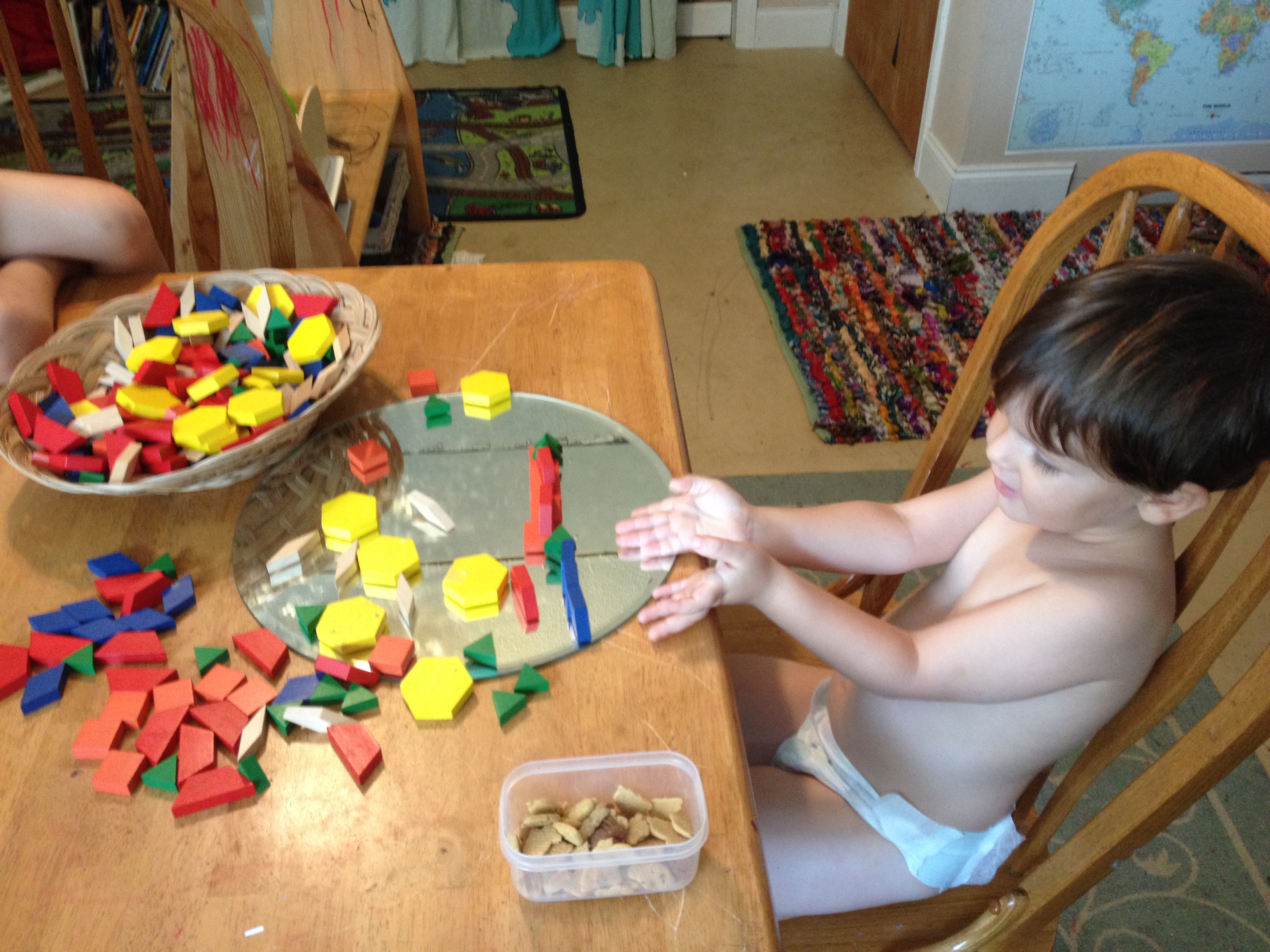
    Whenever hands became cramped we would return to pattern play or working with our lovely Land and Water Forms Map. (10% off Promo code: farm now extended till 9/30/15)

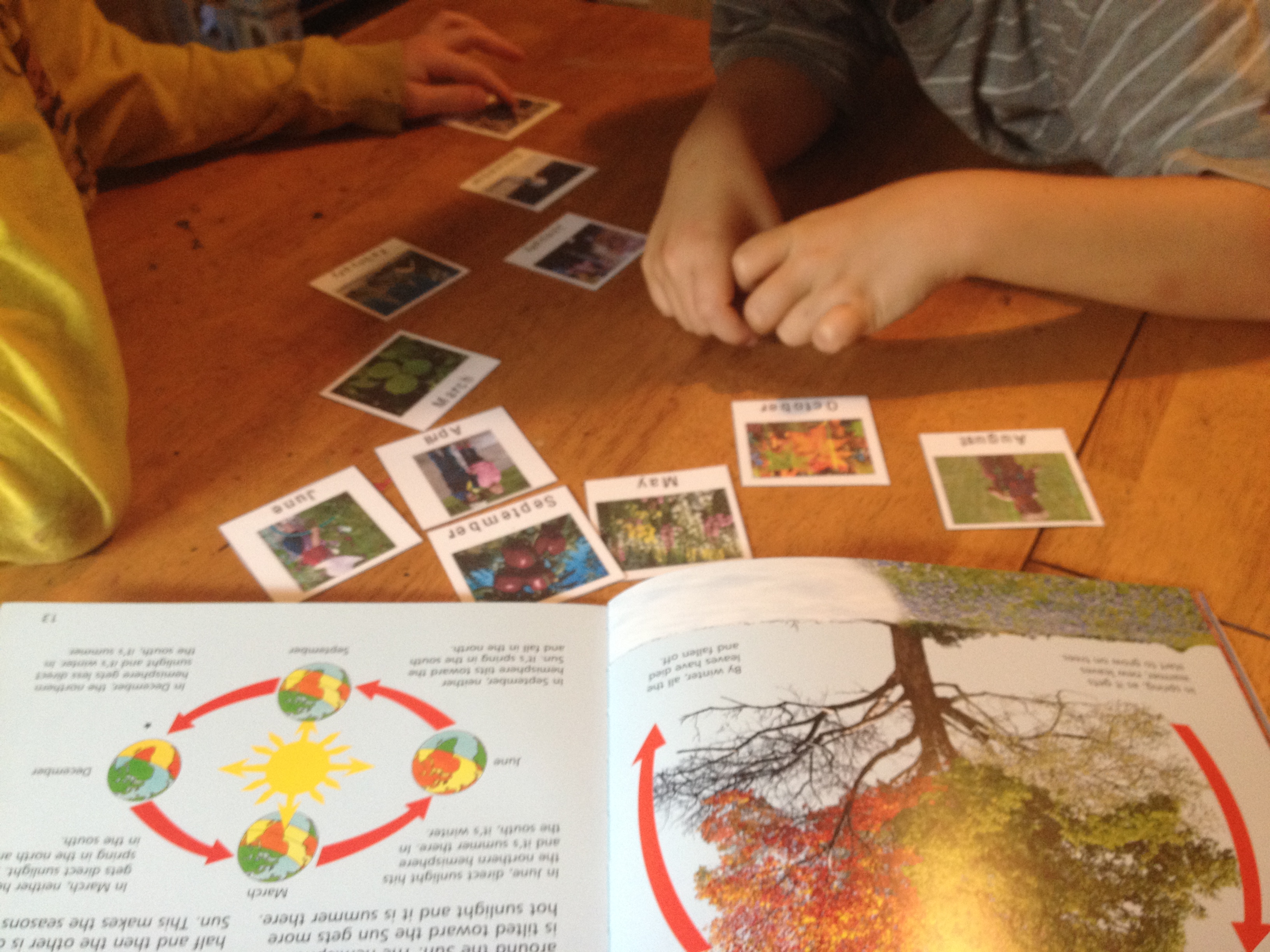
  22. IMG_5642IMG_5664We saved all of our science to do on one day. On Friday we sketched out our trees and leaves. We read “The Reasons for the Seasons” by Gail Gibbons. I set out our Montessori months of the year cards and tried to explain the concept of seasons to these southern-raised one season boys.IMG_5647IMG_5650Unit 9 is done!Now we await a tropical storm and next week’s unit on THE AMERICAN REVOLUTION!

MFW Adventures: Benjamin Franklin & Layers

unnamed-1

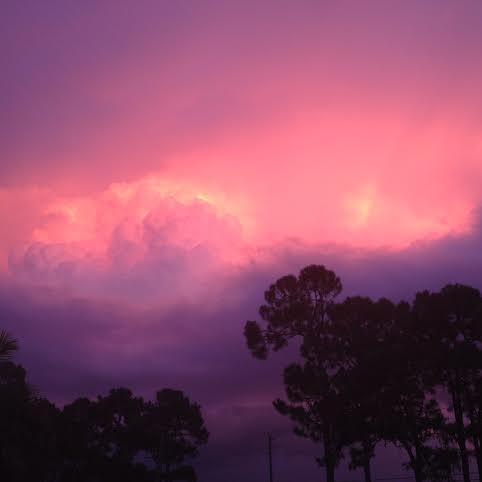
We get a lot of lightning storms. This time of year, we have them almost every day! Our study of Benjamin Franklin coincided nicely with the weather. Last night, the bad weather rolled in just as the sun was setting.

unnamed-2It was overwhelming. Soon after the evening meal, the inside of our home suddenly turned a brilliant golden pink. We ran outside to see what was going on! We were greeted by brilliant colors, the rumble of thunder and powerful lightning bolts transecting the sky’s rosy palette. A great way to end a week of lightning watch. Thanks, God!

IMG_5533

If you’ve been following our blog, you know by now that I am a bit of a book junkie. I hyper focus on books all. the. time.
So I am taking a page out of Ben Franklin’s personal book of improvements and finding ways to improve the way I do laundry homeschool with books. Book overload is not a good thing. I am learning to cut back on book volume and instead of grabbing copious amounts of literature repeating the same information ad nauseaum, I am choosing a few solid books that are well written and beautifully illustrated. I am trying to make sure that our book basket has variety and sustains high interest levels. Do I really need 6 books on Benjamin Franklin that all present the same biographical material? No. For example, we picked up “A Picture Book of Benjamin Franklin” by John Alder at our local library last week. This book is fine but not necessary for our week because it parrots back all the information we received through other sources. We ended up slipping that particular book, along with a few others, back into the library bag.

61zuKVuME5L._SX258_BO1,204,203,200_Benjamin Franklin Book List:
1. Benjamin Franklin Young Printer by Augusta Stevenson We read a few chapters from this biography every night before bedtime. The boys loved hearing stories about Benjamin Franklin as a child. In fact, he simply became “our pal Ben” during these evening readings. How fun to step inside the Franklin family banter! Ben made tough, deliberate decisions even as a child–this  captivated my boys.
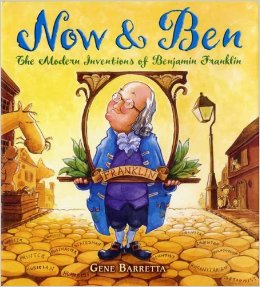
2. Now and Ben by Gene Barretta We loved this book! Bright and engaging. Parallels our world today with the innovations created by Franklin way back “Ben.” The four year old always came sniffing around when this book was pulled out.
3. The Amazing Life of Benjamin Franklin by James Cross Giblin The pictures alone are enough to draw a crowd.
4. Electric Ben by Robert Byrd My boys read this one back and forth to each other.
5. Ben and Me by Robert Lawson Another great chapter book read. This was our lunchtime book and my children are so hopeful for their own Amos.
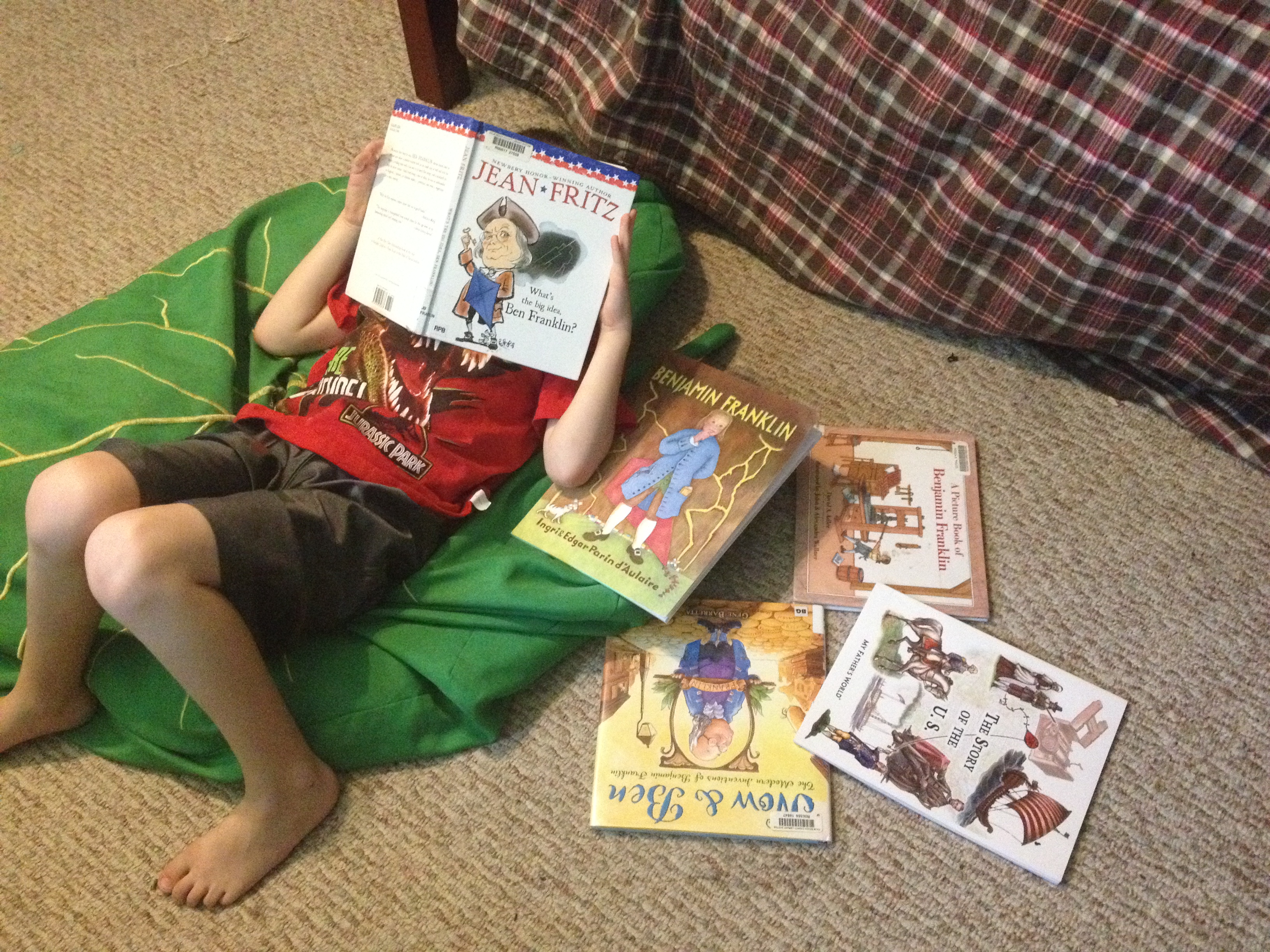
6. Whats the Big Idea Ben Franklin? by Jean Fritz My second born has chosen to read this book on his own. He is 3/4 of the way done and I am excited to hear his “report” when it is finished. I love that he is interested enough to pick up a book on his own.
7. Ben Franklin and the Magic Squares by Frank Murphy Simple enough for my son to read by himself. He came running into my office, waving the book and begging for help so that he could make his own “magic squares.” He made magic squares all week long.
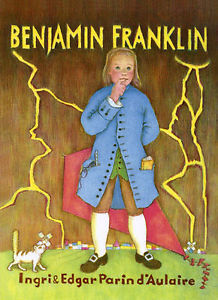
8. Benjamin Franklin by Indri D’Aulaire Our primary resource (outside of The Story of the U.S.) Beautiful, informative, incredibly engaging.

IMG_5602

Our Beautiful Feet study has now synced up perfectly with MFW Adventures. We read the D’aulaires book, “Benjamin Franklin” each morning while coloring in the free pages provided by bfbooks.com.

$_35

One of our favorite chapters in the book, “Ben Franklin, Young Printer,” describes Josiah Franklin’s undercover methods of educating his children. Josiah and Abiah would invite guests over for dinner and through carefully crafted questions, lead the guests through a series of informative conversations that would edify their children and open the world to them while their little feet remained planted under the dinner table.
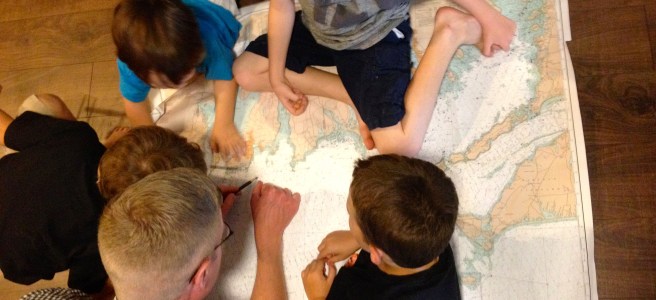
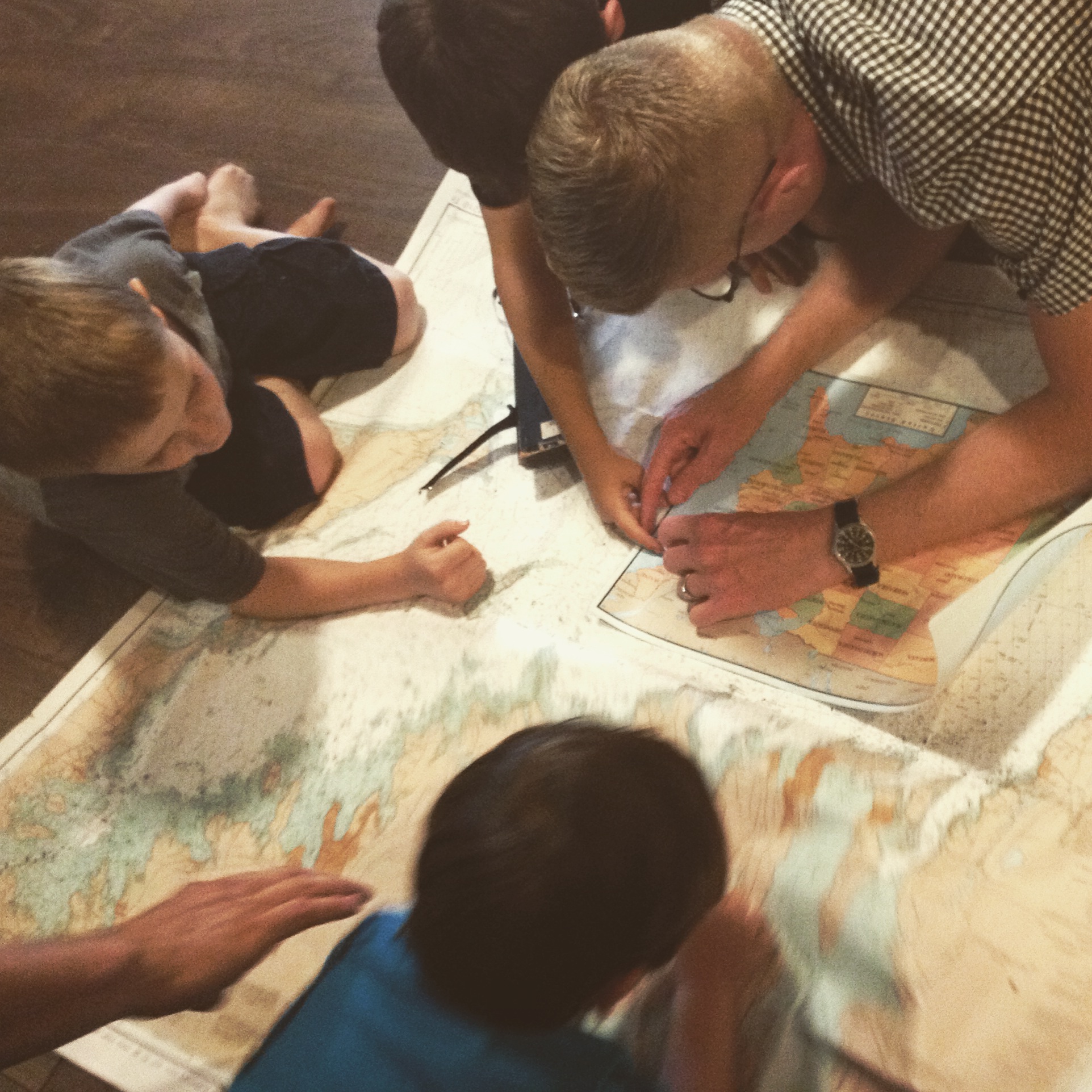
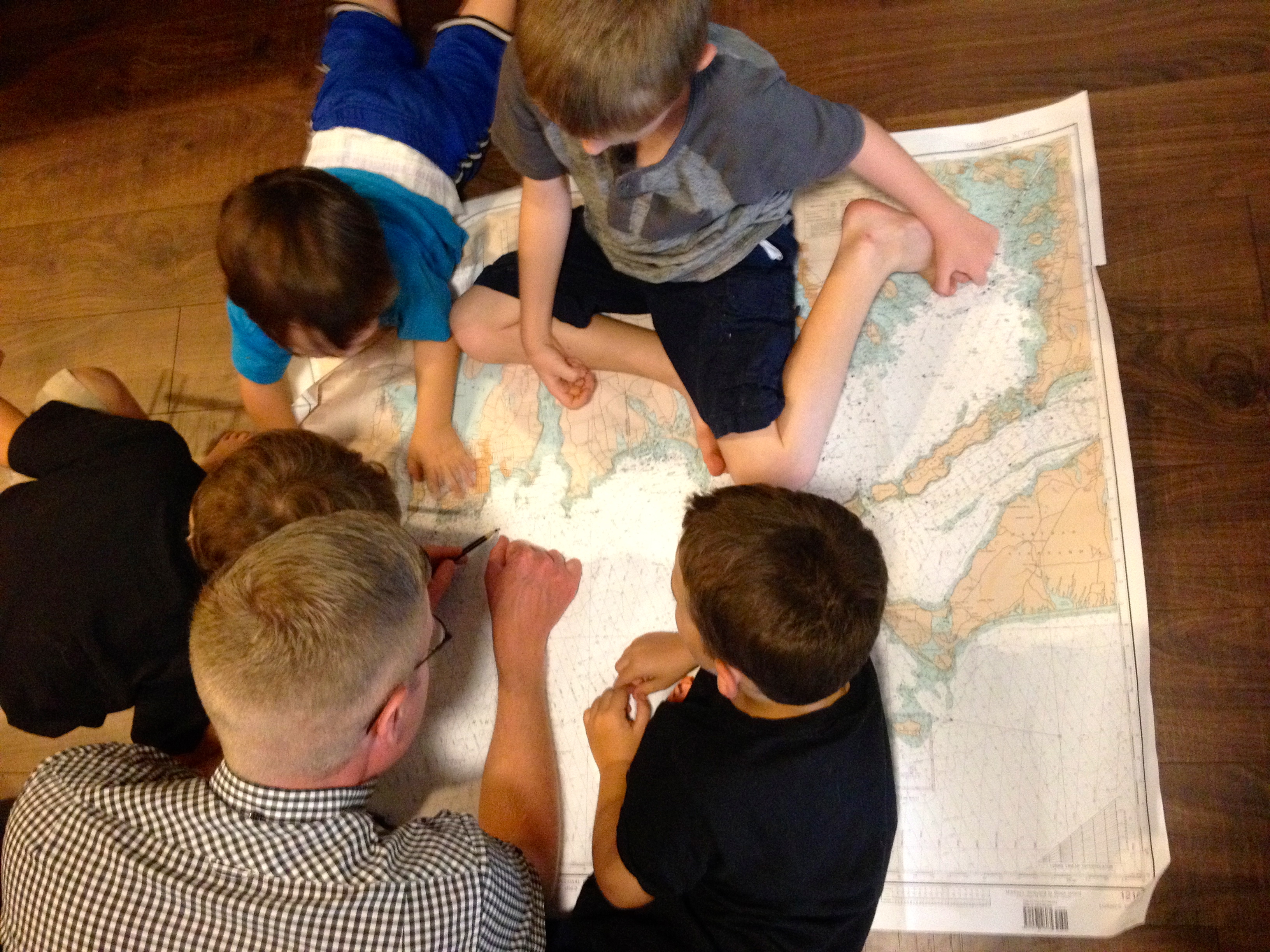
IMG_5513Now on his return trip home, Uncle Captain David stopped by for pizza and brought along his sea charts. Once the pizza was consumed, the chart was placed on the floor,  measuring instruments were brought out and my children were soon learning how to plot courses around buoys, shipwrecks and shallow water.

IMG_5518 My eldest remarked later, “I think we should do this kind of Franklin School Style more often!” We are so thankful for a wonderful visit with our dear friend and for his willingness to sprawl out on the living room floor and talk to our boys about the things he is learning.

IMG_0124 I would have loved to spend our week outdoors doing fun Ben Franklin Activities as originally planned; but the heat, lightning and mosquitoes convinced us otherwise. The great outdoors are a great misery right now. I didn’t want the kids bouncing off the walls all week. (This summer we are averaging 3 nose bleeds a day thanks to wrestling, wiggling and plain-old “not watching where you walk”). How to have a fun week learning about Ben Franklin with minimal outdoor time while also avoiding meaningless handouts? Hmmm…

Dare we try lap-booking?

Confession: I never really fancied myself a “lap book” kinda gal. They seemed like an inordinate amount of work for Moms with mixed reviews on how much kids actually learned. The endless copying, card stock, glue, coloring, assembling–yay! More “Things to Do.” I wondered what percentage of these books were actually put together by children? Also, anything that feeds my Type A personality in a negative way is something I tried to avoid. Lap books just seemed like the homeschool version of crystal meth for my personality. (RUN AWAY!) Anyways, my boys have loved Ben Franklin for many years (devotion to the point of attempting non-sanctioned haircuts in B.Franklin’s money style) and they wanted to do a BIG PROJECT when we reached our pal Ben during Adventures. You know whats coming….

We finished a lapbook.

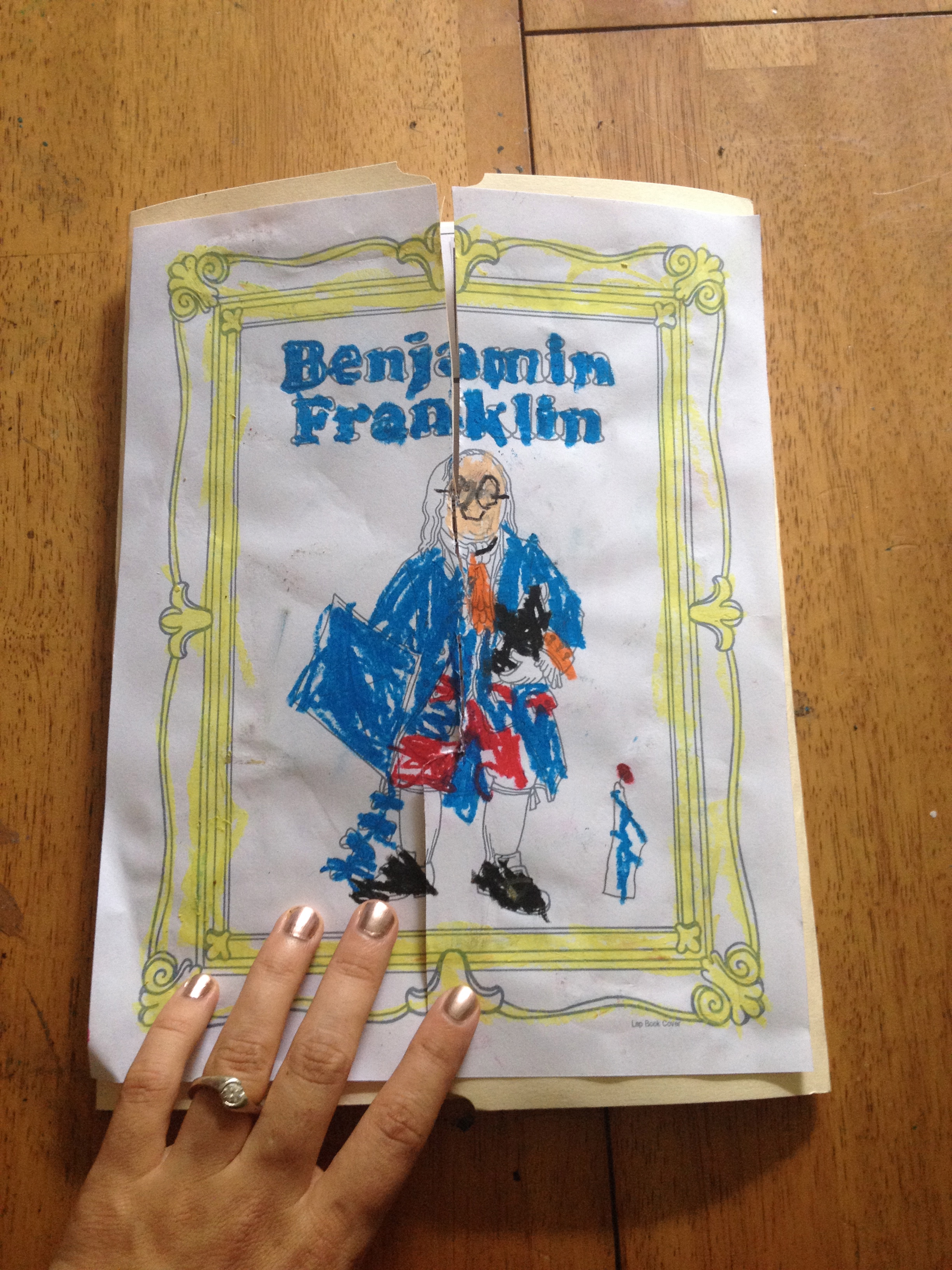
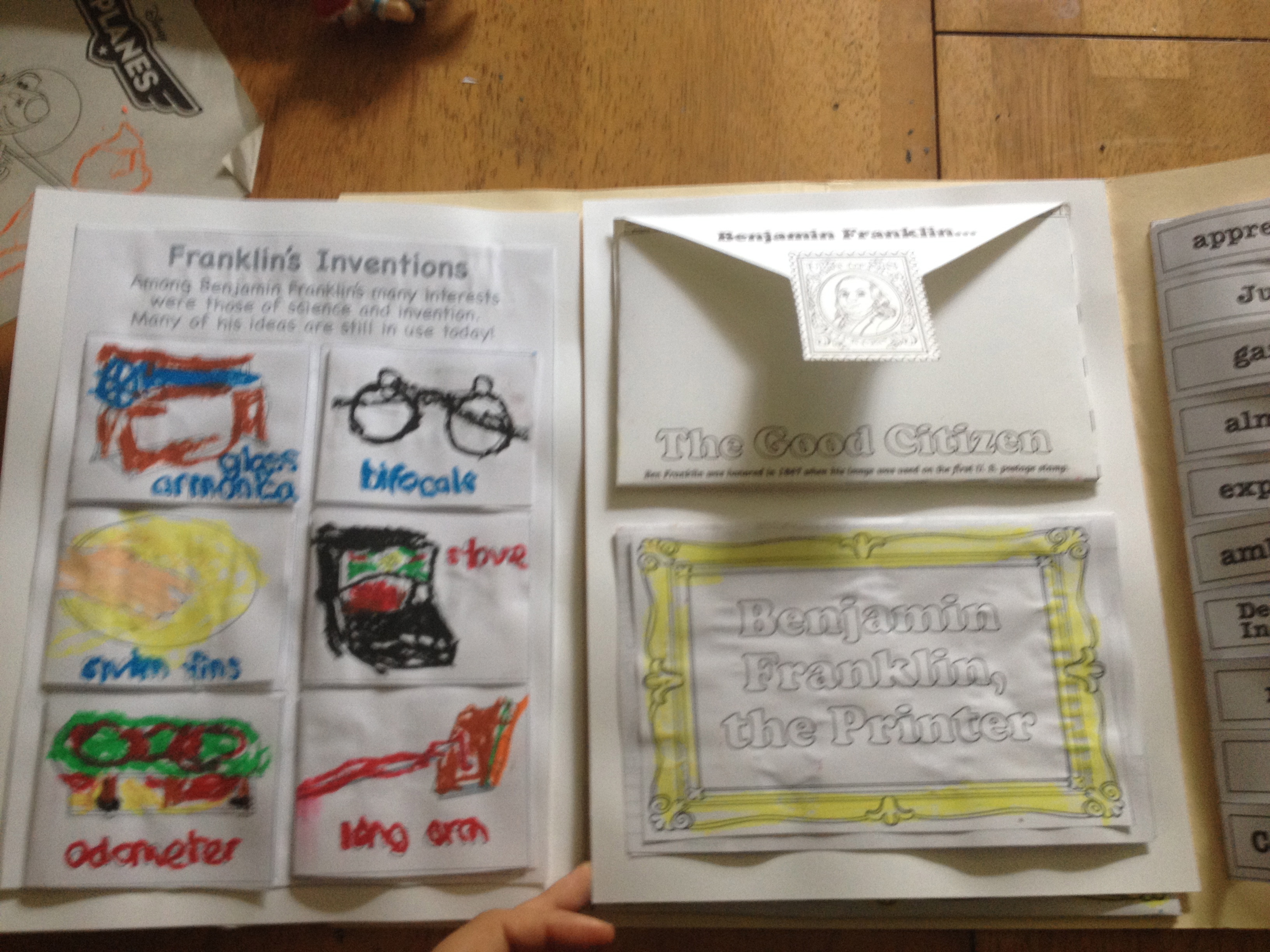
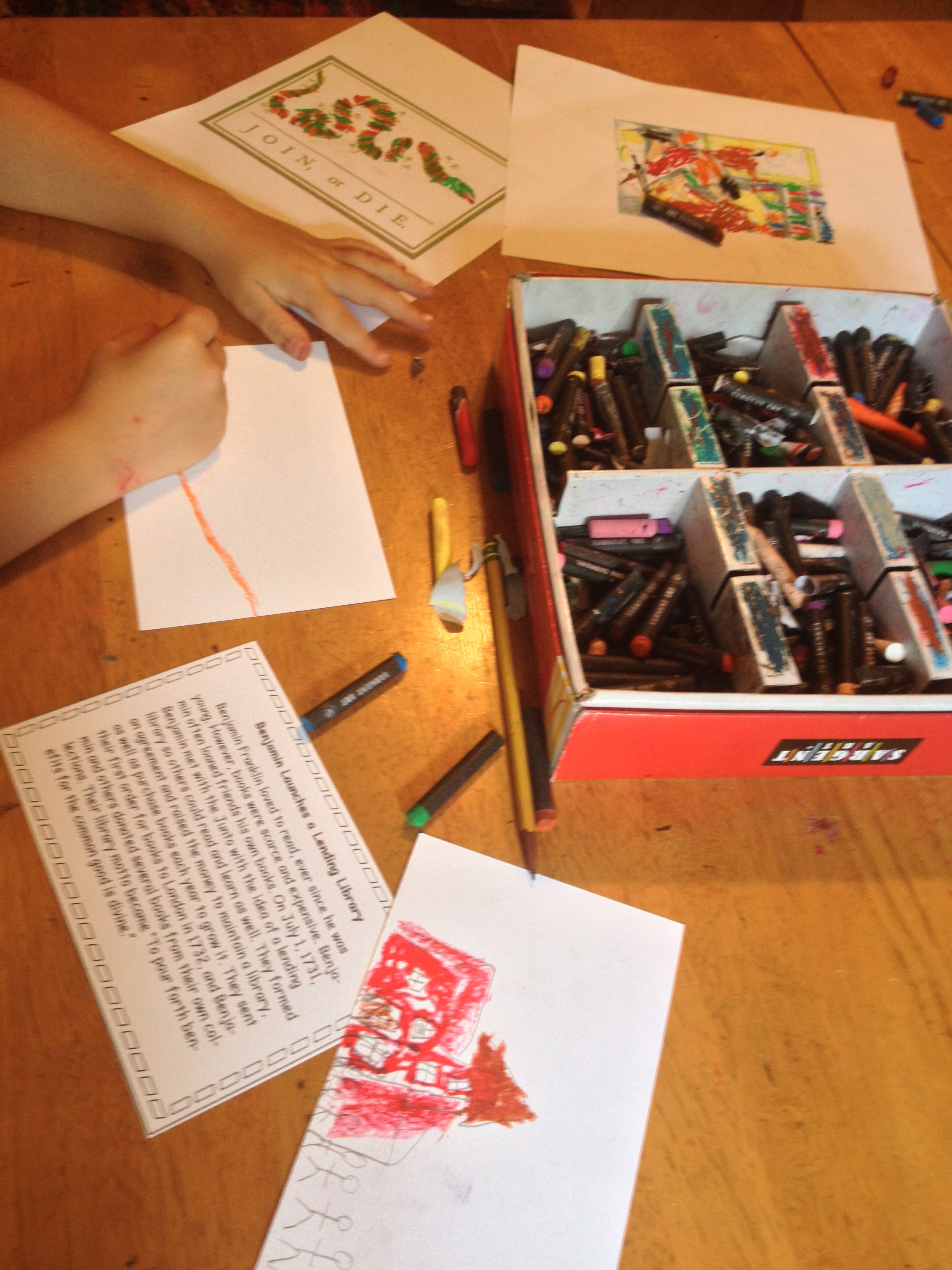
IMG_5603 Or rather, THEY finished a lapbook. Yup, we took the plunge. As you can see from the cover page, I was not in charge of coloring. I certainly did the majority of the assembling, but these boys took charge!

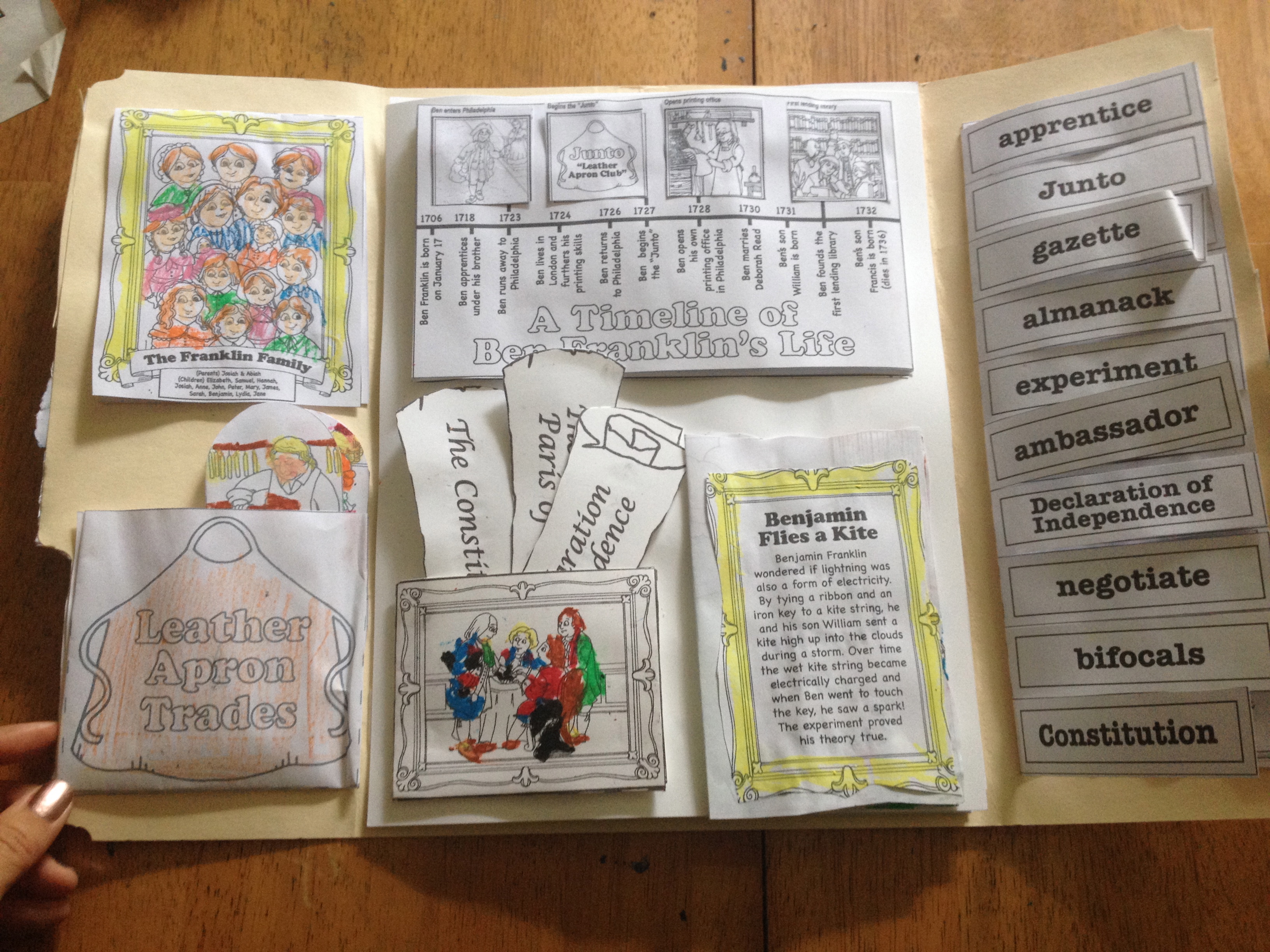
Homeschool in the Woods lap-pak study of Benjamin Franklin was incredibly fun and meaningful.  The instructions are clear and precise.  The Benjamin Franklin book we assembled was lovely and I am so thankful that it came with Audio accompaniment. I was able to leave Team A coloring, cutting materials and listening to audio, while Team B and I sorted laundry on the other side of the house.

IMG_5604I was a bit worried that we would overload on the Franklin family if we integrated this lap-pak with our MFW study, but it complemented everything quite nicely. The boys were always looking forward to the next small project. If they did not have such a high degree of interest then the lap-pak thing just would not have worked for us. But these boys wanted more! And the lap-pak delivered.
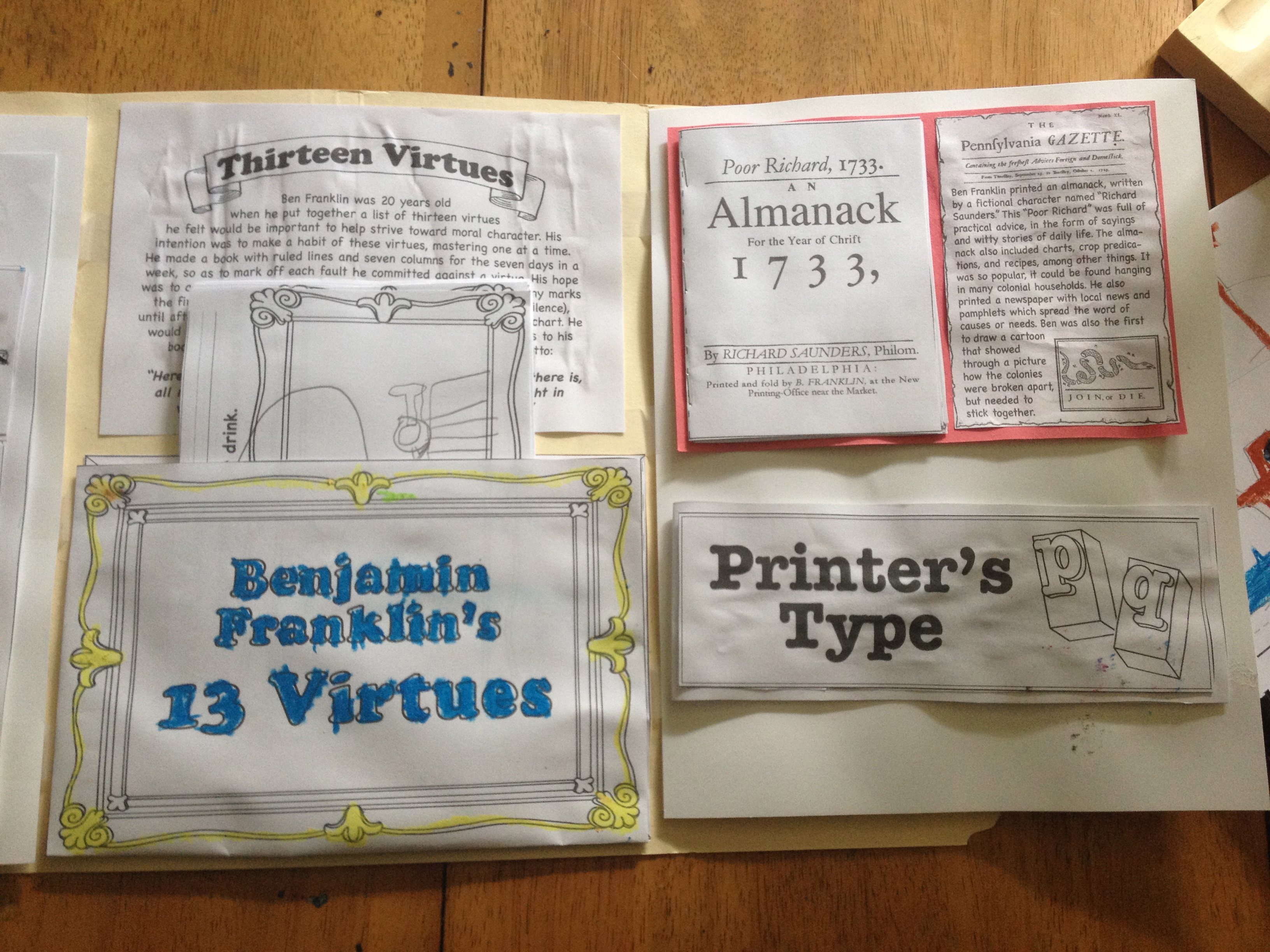
IMG_5605Leather apron trades, inventions, timelines, contributions, documents, etc.  Kudos to Homeschool in the Woods for this thoughtfully prepared material. My eldest loved getting to set the type for his own name with all the letters placed backwards and then seeing it close down on his name with the letters facing the right way. The second-born loved reading about Ben’s inventions and setting up the printing press diorama.
IMG_5606Once we assembled the books, I carved 10-15 minutes out my day with each son so they could walk me through their lap-pak. They were so proud of their hard work and eager to relay as much information as they could.

“See this armonica? Mozart liked it so much he made music for it. Thats how awesome Ben Franklin was. I want to build an armonica because you can’t get them in a store. They are in museums now.”
“All the printer’s type go in backwards because when it presses down then the letter go the right way. Its a mirroring thing, you know?”
“Just think about how important the Treaty of Paris was, you know Mom? And Ben Franklin helped write it and sign it! He was already pretty old by then so he had to use the bifocals he invented.”
“This is all the stuff he did. This line right here stops right before he’s your age Mom, which means he did all this before he was your age!” 
“Ben Franklin practiced these 13 virtues. My favorite is Temperance but really I think we could all use more Silence.”  

IMG_5561

If Ben Franklin is just another week for you, proceed as planned. But if your kiddos have a special interest in him and would enjoy something “extra” then I recommend this lap-pak with two hearty thumbs up. (PS. Its geared for grades k-2). The boys learned a lot about the life of Ben Franklin and the importance of following directions. I learned that I am a lap-book “once in awhile” kinda gal and am in no danger whatsoever of becoming addicted.

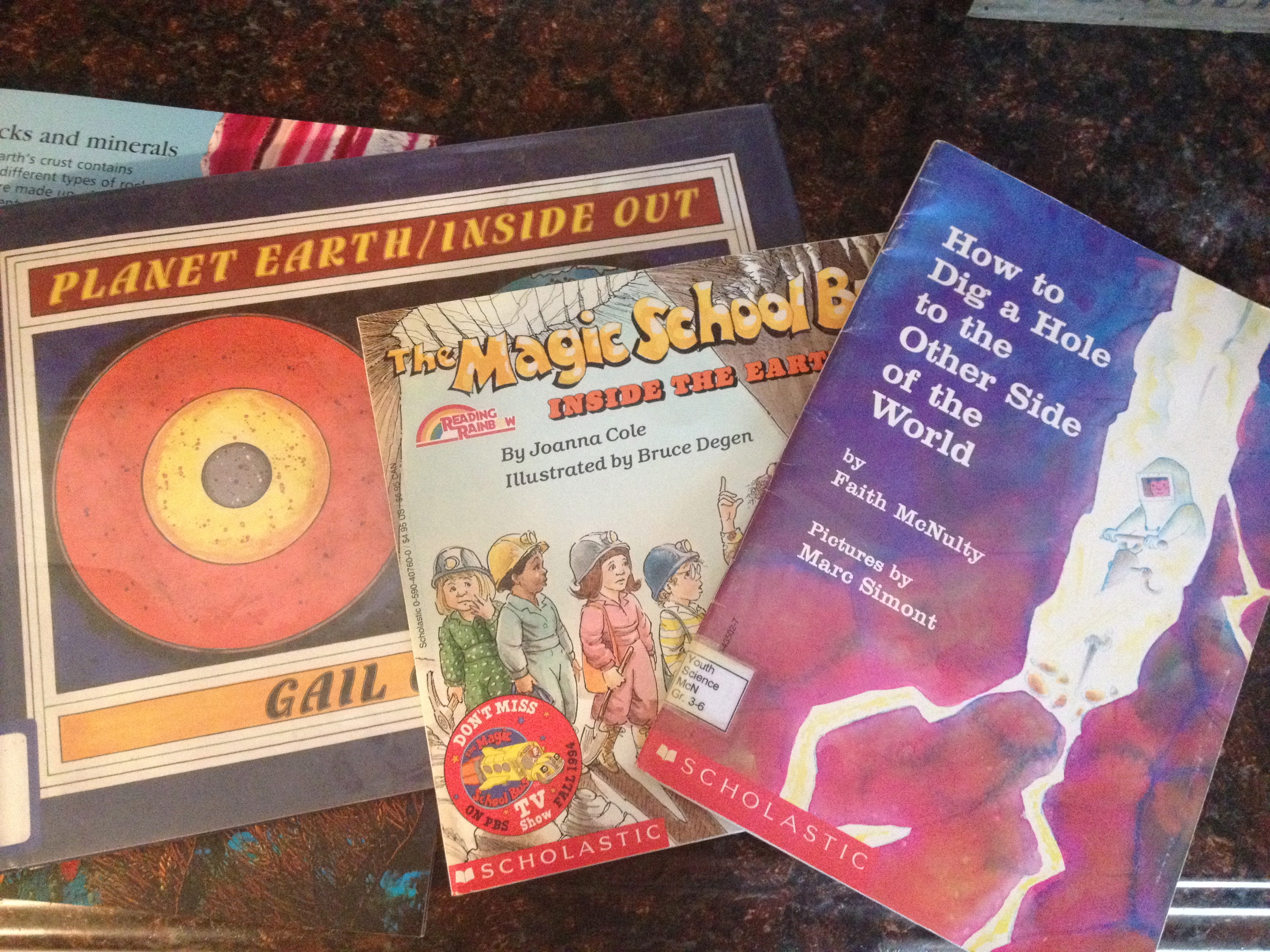
Last but not least, SCIENCE.IMG_5537Lots of Magic Schoolbus  over here! Beep, beep! We love reading Faith McNulty’s “How to Dig a Hole to the Other Side of the World.” Its one of our favorite books to read on a fairly regular basis.

IMG_5538

This year I deliberately included Gail Gibbon’s “Planet Earth/ Inside Out.” This book uses evolution and big bang terms throughout. I walked the boys through the basics of each theory using the book. We looked at the creation account (even browsed through our old MFWK Creation books) and then reread “Planet Earth/Inside Out.” Plenty of discussion and great questions. I had to look up a few things and the boys followed along as I researched. The second born was fascinated by Robert Ballard’s current research of the biblical flood’s impact on an ancient shoreline at the bottom of the Black Sea.  My eldest wants to research the possibility of pangea’s existence before the flood and the subsequent break up as a result of the flood. I love that he is wondering about that. I am glad that he is sorting through questions about creation and evolution while at home. I went to an evangelical college with a lot of kids that were taught nothing but creation at home and then went through major crises once they arrived in science class and began learning all these theories. I love that homeschooling provides platforms for researching and asking questions together about the beautiful mysteries of the universe our God so lovingly created.

IMG_5539
How fascinating is our earth? The boys resounding question was “But how do scientists know this FOR SURE?” They are hungry to learn more about the scientific method and the history of science in general.
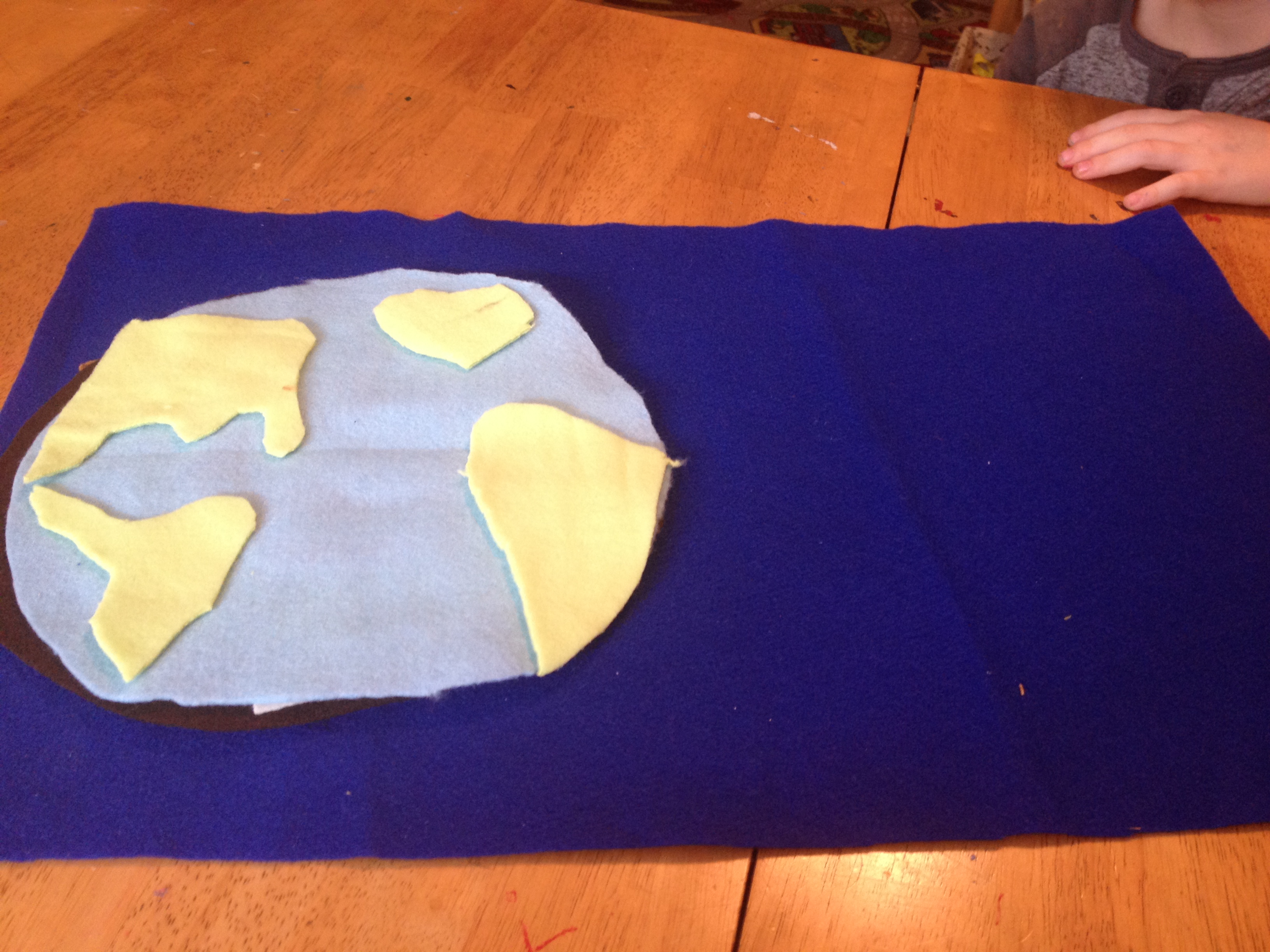
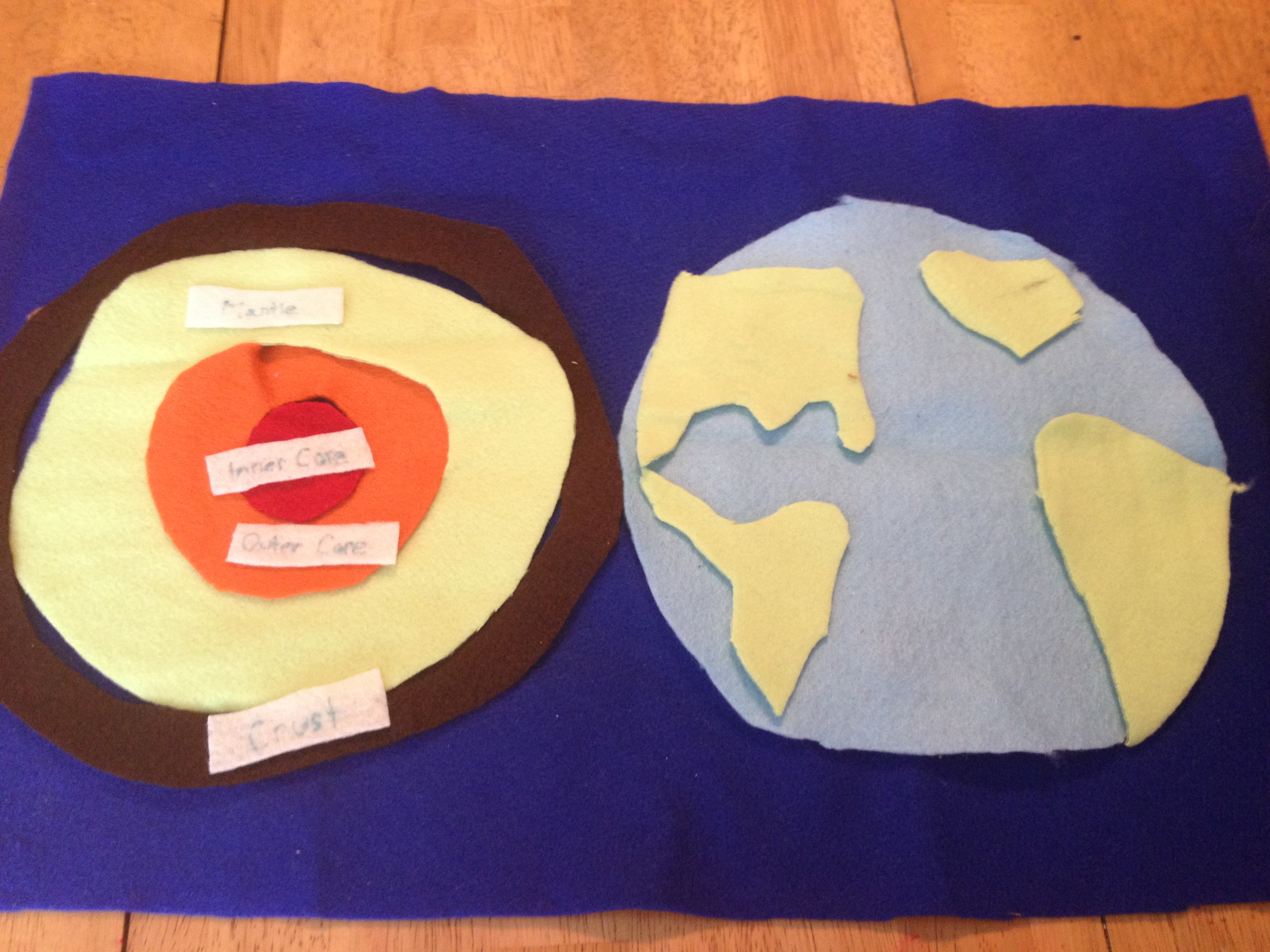
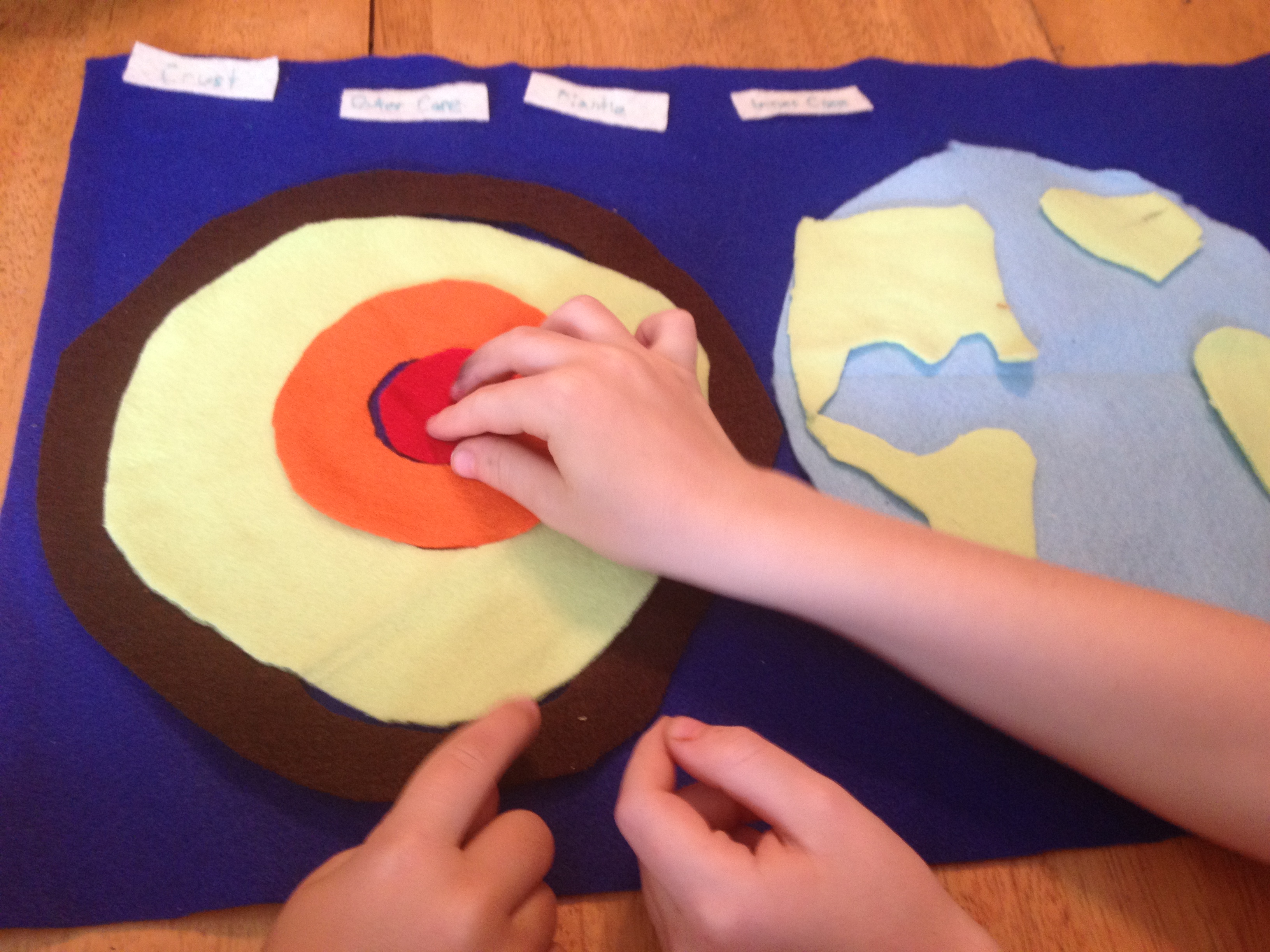
I made a pretty ugly and haphazard basic felt puzzle for the boys to play with. They loved sorting the layers of the earth and labeling the various pieces, all the while asking for MORE INFORMATION! Something tells me that our high school science years will be quite the doozy!
IMG_5541
Next week we begin our study of my eldest son’s all time favorite person ever: George Washington! We may be taking more than a week to finish our study, we plan on enjoying it to the fullest!
Happy Adventuring, friends!
f557b73e4f3efce0e027d7829429187e

The Morning Hour: Listening, A Way of the Spirit

unnamed-2

The morning hour is one of the best times to work in reading aloud into our daily rhythm. Specifically, breakfast time.

I have a captive audience upon which to pour out beauty–for my children and for myself to soak in.

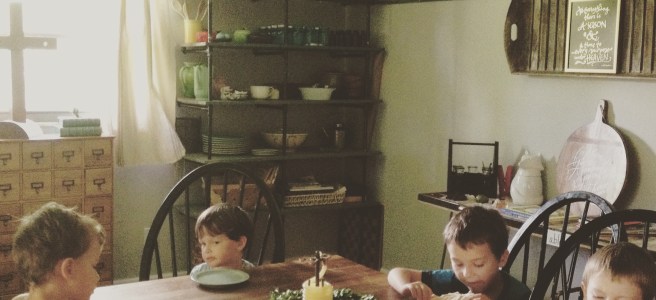
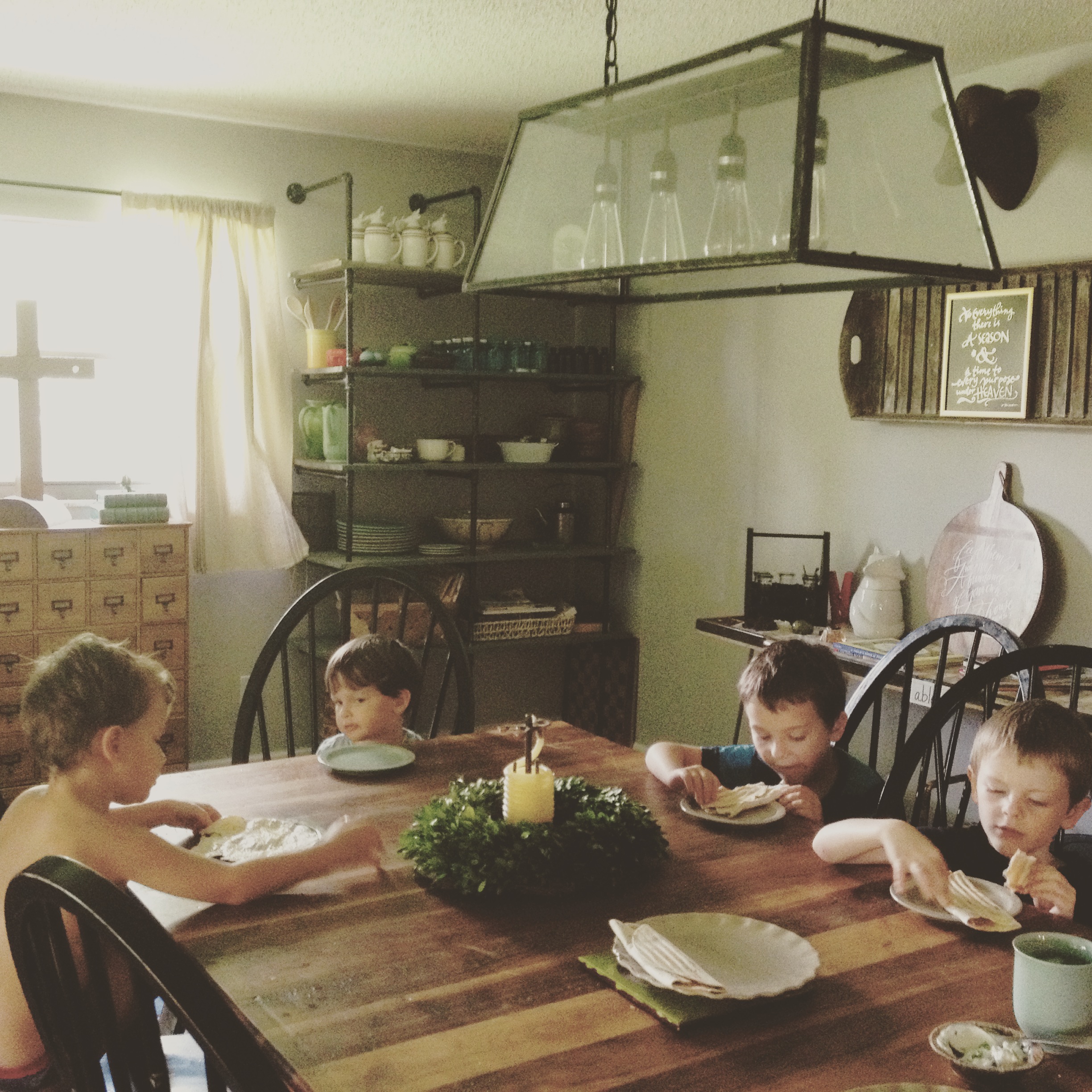
Starting the day off with something beautiful and purposeful, gently nudges us in a good direction. Even when kids are crabby and upset (TANTRUM), its good to know that we have this block of uninterrupted time to move slowly and work out kinks. Breakfast is a long affair at our house. Not fancy, just slow. The boys set out their dishes, napkin, cups. They pour out their drinks and sit down to wait for their food. Sometimes its just Ezekiel bread right out of the bag with a pat of butter on it.

We set things up, we pray and then, we experience beauty!
We are never in a hurry to finish.

They need time to think and absorb and process.

There are days when it takes 7 minutes start to finish and they are racing off to find an activity.

But there are also days when little hearts have questions they don’t know how to ask aloud and gentle patience is needed.

So I read to draw out their hearts. I read to pour in a piece of truth that will soak down into those soft pink ears to light upon their souls.

unnamed

We are currently reading through several poetry collections. We read one or two poems in the morning as a fun warm up. Oftentimes the kids will beg for more or ask for one long poem to be read out loud again. They have surprised me by memorizing several small poems after only a few readings. My boys love the cadence of poems. The certainty of what the next sound will be and the uncertainty of where the poet is taking them—calculated suspense! Poetry is adventure.

Next, we will read a lovely story. This book is almost always focused on virtue or character building.  We have read excerpts from biographies, short stories, children’s fiction, and allegories. The qualifications are simple: beauty and truth.

Composer study, Artist study, and hymn singing are also treasured parts of the morning.

Lastly, we read a brief devotional from a study to close out the breakfast hour. We are currently reading through some devotions by Sally Michaels, who has become a household favorite! (I will include all book links at the end of the post).

1 or 2 poems
A story
1 small devotional

That has been the routine for many years. But now, we have a pair of second graders ready to read the Scriptures on their own.

I have never taught anyone how to read Scripture. Perhaps I will have fancier goals as time marches on, but for now the goal is simply this…

I want my children to be confident navigating the Word so they can feed themselves from Scripture.

I don’t want them to be depending upon me for their sole Scripture reading. Not at this stage in the game.  We will still read the Bible as a family, but they must now take up their swords and learn how to wield them on their own.

Our four and two year olds will be excused after the short devotional and the two elder children will be studying their own Bibles for 5 minutes.

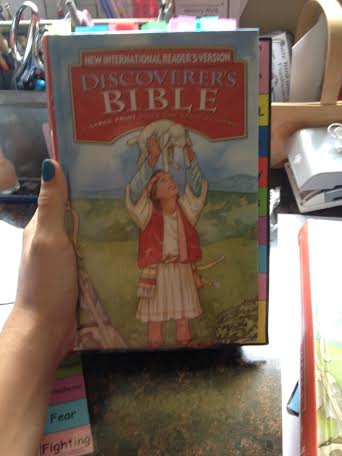
The Discoverer’s Bible is a large print Bible for early readers. We have incorporated the Child Training Bible program to help them in learning to navigate this precious tool.

unnamed-3

unnamed-4

The CTB includes 6-7 heavy-weight pages of guide material. The guide provides boxes with key struggles in grid form. References are provided so parents can hi-light and tab, related Scripture. My kids can open their Bibles and study the topic of “Anger,” together. They will read the prompt and discuss an example from the life of Jesus that I read to them. Then they will find the yellow box that says “ANGER”,  they will look in their Bibles and find all the yellow tabs on top, which lead to pages containing anger related verses hi-lighted in yellow. They are free to discover these verses and read them aloud or to themselves. Overtime they will become more familiar with where books of the Bible are found and will have read over 200 scripture references concerning struggles like “Fighting, Not Listening, Fear, Pride, Disobedience.”

I do wish the CTB incorporated other topics, like the Fruit of the Spirit, but for now it helps us in behavior training and Scripture training in a valuable way. I am glad that they have a thorough section entitled “The Gospel.”

I’ll let you know how things progress as the kids learn to feed themselves from Scripture!

Check out Ann Voskamp’s routine: “Listening: a Way of the Spirit” for more inspiration!

BOOK LIST

Poetry Collections:
A Garden of Verses by Robert Louis Stevens
Now We are Six by AA Milne
The Oxford Illustrated Book of Children’s Poems Edited by Donald Hall
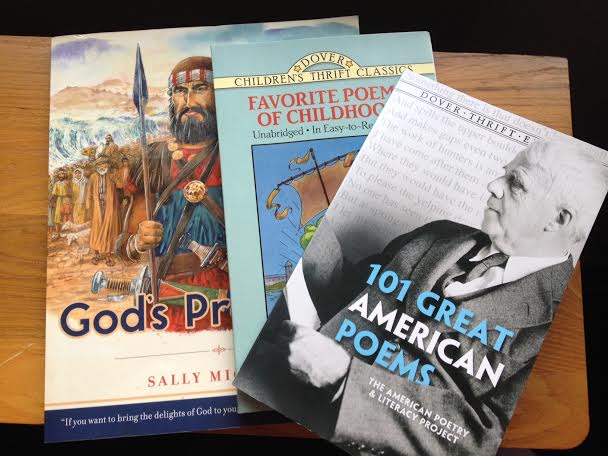
101 Great American Poems
Favorite Poems of Childhood Edited by Phillip Smith

Stories:
10 Boys Who Made History by Irene Howat
10 Boys Who Made a Difference by Irene Howat
10 Boys Who Used Their Talents by Irene Howat
10 Boys Who Changed the World by Irene Howat
10 Boys Who  Didn’t Give In by Irene Howat
(Girl counterpart books found here).
Trial and Triumph by Richard Hannula
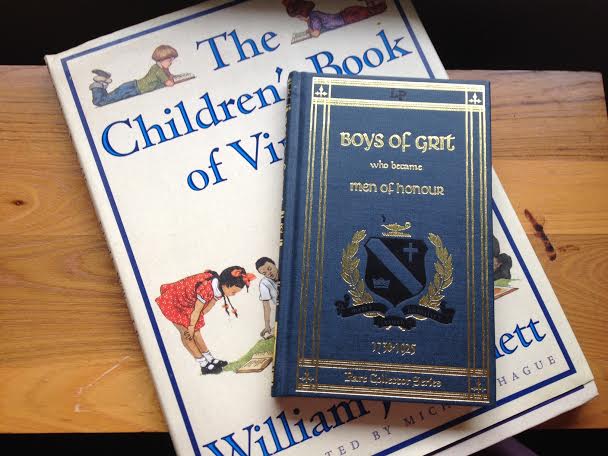
Boys of Grit Who Became Men of Honor by Archer Wallace
The Children’s Book of Faith by William J Bennet
The Children’s Book of Virtues by William J Bennet
Something from Nothing by Phoebe Gilman
The Quiltmaker’s Gift by by Jeff Brumbeau
When Daddy Prays by Nikki Grimes
The Circle of Days by Reeve Lindbergh
Song of Creation by Paul Goble

Devotions:
Five-Minute Devotions for Children by Pamela Kennedy (Many in the series)
Training Hearts Teaching Minds by Starr Meade
God’s Names by Sally Michaels
God’s Promises by Sally Michaels
God’s Wisdom by Sally Michaels
God’s Providence by Sally Michaels
God’s Battle by Sally Michaels
God’s Word by Sally Michaels
Thoughts to Make Your Heart Sing by Sally Lloyd Jones

Homeschool Booklist

A list of books (with links) to my favorite Homeschool Life reads of all time!

These books range from peacekeeping to philosophy of education to child rearing.

Parenting/Family
Peacemaking for Families by Ken Sande & Tom Raabe
The Peacemaker: A Biblical Guide to Resolving Personal Conflict by Ken Sande
Practicing Affirmation: God-centered Praise of Those Who Are Not God by Sam Crabtree
Loving the Little Years: Motherhood in the Trenches by Rachel Jankovic
The Heart of Anger by Lou Priolo
Do Hard Things by Alek and Brett Harris
Raising a Modern Day Knight by Robert Lewis
Training Hearts Teaching Minds by Starr Meade
Give Them Grace:Dazzling them with the Love of Jesus by Elyse M. Fitzpatrick
Grace Based Parenting by Dr. Tim Kimmel
Teach Them Diligently by Lou Priolo
Laying the Rails from Simply Charlotte Mason

Homeschool Family Help/Life Help
Mere Motherhood by Cindy Rollins
Help for the Harried Homeschooler by Christine Field
Time Management for Unmanageable People by Ann Cooper
No Ordinary Home: The Uncommon Art of Christ-centered Homemaking by Carol Brazo
The Shaping of a Christian Family: How My Parents Nurtured My Faith by Elizabeth Elliot
Beyond Survival:Guide to Abundant Life Homeschooling by Diana Waring
Margins: Restoring Emotional, Physical, Financial and Time Reserves to Overloaded Lives by Richard Swenson
Contentment: The Secret to Lasting Calm by Richard Swenson
For the Family’s Sake by Susan Schaeffer Macauley

Homeschool Guides/Philosphy of Education
Teaching from Rest: A Homeschooler’s Guide to Unshakeable Peace by Sarah Mackenzie
For the Children’s Sake by Susan Schaeffer Macauley
Charlotte Mason Companion by Karen Andreola
Ten Ways to Destroy the Imagination of Your Child by Anthony Esolen
Death by Living by N.D. Wilson
Simply Classical: A Beautiful Education for Any Child by Cheryl Swope
The Well Trained Mind: A Guide to Classical Education at Home by Jesse Wise and Susan Wise Bauer
The Core: Teaching Your Child the Foundations of Classical Education by Leigh Bortins
The Educated Child by William J Bennet
A Mind at a Time by Mel Levine
The Ultimate Guide to Homeschooling by Debra Bell
Educating the Whole Hearted Child by Clay & Sally Carkson
The Homegrown Preschooler by Kathy Lee & Lesli Richards
Saving Leonardo: A Call to Resist the Secular Assault on Mind, Morals and Meaning by Nancy Pearcy ** All her titles are exceptional.

Stay tuned for more book lists!